Production volume dictates machine type: Operations under 10 million bags annually benefit from premade pouch systems; 10-50 million bags favor VFFS; volumes exceeding 50 million justify HFFS or high-speed VFFS for optimal cost per bag.
Material costs dominate total cost of ownership: Rollstock film ($0.005-$0.010/unit) costs 50-75% less than premade pouches ($0.010-$0.020/unit), making premade pouch systems 45% more expensive over five years despite lower labor requirements.
Servo-driven machines reduce changeover time by 50-70%: Digital recipe storage and automated adjustments cut VFFS changeovers from 45-60 minutes to 20-30 minutes, directly improving throughput for multi-SKU operations with 2+ changeovers daily.
HFFS delivers maximum speed but limited flexibility: Horizontal systems achieve 300-600+ packages per minute, double VFFS speeds, but require 30-90 minute changeovers and handle only 1-3 SKUs effectively, making them ideal for high-volume single-product lines.
Preventive maintenance prevents 80% of failures: Weekly spindle alignment checks eliminate most VFFS tracking problems; daily seal peel tests catch 85-92% of seal failures before production impact; proper maintenance improves MTBF from 2,000-4,000 hours to manufacturer specifications.
Selecting the right bagging machine determines production capacity, labor costs, and product quality for years to come, yet most manufacturers struggle to navigate the technical specifications and cost trade-offs between vertical form-fill-seal (VFFS), horizontal form-fill-seal (HFFS), and premade pouch systems. This guide cuts through the complexity with data-driven comparisons of speed ranges, changeover times, total cost of ownership, and application-specific recommendations.
Whether you're packaging 1 million bags annually or 100 million, understanding which bagging machine types match your production requirements prevents costly mismatches and maximizes return on investment.
Understanding Bagging Machines: Key Benefits For Modern Production
Automated bagging equipment forms, fills, and seals packages from rollstock film or premade pouches in a continuous operation. These systems replace manual packaging lines, delivering consistent output at speeds manual workers cannot match. The right machine selection directly impacts labor costs, production capacity, and product quality.
Core Benefits of Automated Bagging:
Speed: VFFS machines operate at 50-300 packages per minute; HFFS systems achieve 300-600+ ppm for maximum throughput
Labor Reduction: Automated systems reduce packaging labor from 20 workers to 5 workers, cutting direct labor costs by 75%
Accuracy: Fill accuracy reaches 99.5%+ with multihead weigher integration, meeting strict weight compliance requirements
Consistency: Seal reliability of 95-99%, depending on machine type, ensures product integrity and reduces customer complaints
Waste Reduction: Properly calibrated machines reduce product waste from 5-8% to under 2%, improving material utilization and profitability
The 5 Main Types Of Bagging Machines
Five primary form fill seal machine categories serve different production requirements: manual/open-mouth baggers for low-volume applications, VFFS for versatile mid-speed packaging, HFFS for maximum throughput, and premade pouch machines for premium branding with quick changeovers. Selection depends on production volume, SKU count, changeover frequency, and capital budget.
Main Bagging Machine Types
Machine Type
Speed (ppm)
Capital Cost
Best For
Changeover Time
Manual/Open-Mouth
10-40
$5,000-$30,000
Low volume, irregular products, large bags (25-50 lb)
5-10 min
VFFS
50-300
$3,000-$90,000
Multiple bag styles, moderate volume, 4-10 SKUs
20-60 min
HFFS
300-600+
$4,500-$140,000
Maximum speed, single product, individual items
30-90 min
Premade Pouch
35-120
$15,000-$50,000
Premium branding, 10+ SKUs, frequent changeovers
10-30 min
Servo-driven machines reduce changeover times by 50-70% compared to mechanical systems through digital recipe storage and automated adjustments. Real-world throughput efficiency varies by machine type: HFFS delivers 75-85% efficiency, VFFS achieves 60-75%, while premade pouch machines reach 80-90% due to simpler operations and fewer mechanical adjustments. Footprint requirements scale with speed: premade pouch machines require 100-200 sq ft, VFFS needs 150-300 sq ft, and HFFS demands 200-400 sq ft for complete line integration.
VFFS vs. HFFS: Understanding The Critical Differences
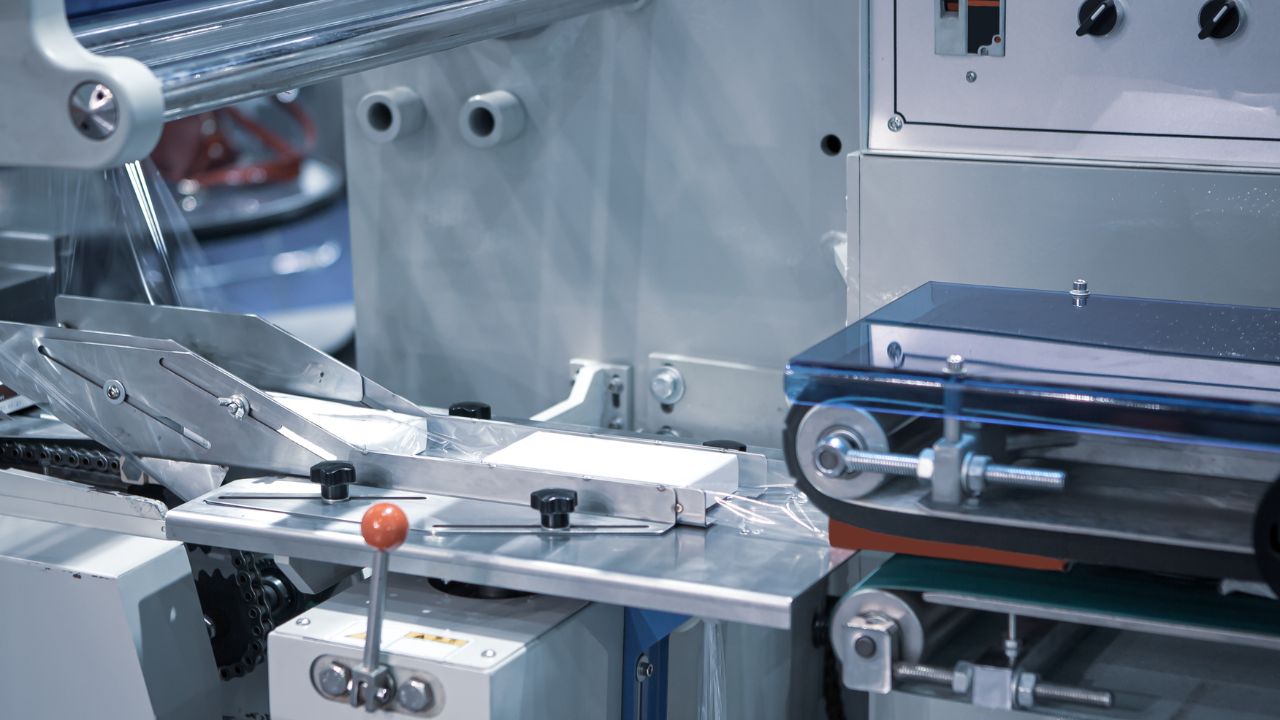
Vertical and horizontal form-fill-seal machines represent fundamentally different packaging approaches. A vertical bagging machine forms bags vertically around a central tube, offering maximum bag style versatility. HFFS wraps film horizontally around products, delivering the fastest speeds for individual items. The choice between them depends on required throughput, bag style needs, and product characteristics.
Powders, granules, snacks, liquids, multiple bag styles
Individual items (candy, cookies, medical devices), maximum speed
VFFS forms bags vertically with product dropping through a central tube, enabling diverse bag styles from pillow pouches to quad-seals. HFFS wraps film horizontally around products already on conveyors, maximizing speed but limiting bag style options. Changeover frequency significantly impacts annual throughput: three changeovers per day reduces VFFS throughput by 15% and HFFS by 13%, making servo-driven machines essential for multi-SKU operations.
For operations requiring maximum speed with limited SKU changes, HFFS delivers unmatched performance; for manufacturers needing bag style versatility across multiple products, VFFS provides optimal flexibility.
Matching Machine Type To Your Product And Production Needs
Product characteristics and production volume determine which machine type delivers optimal performance and cost-effectiveness. Physical properties like flowability, fragility, and viscosity dictate filling method and handling requirements. Annual volume and SKU count directly impact equipment selection and ROI calculations.
Product Type Recommendations
Product Type
Recommended Machine
Speed
Special Requirements
Powders/Granules
VFFS with auger filler
100-250 ppm
Antistatic bars; multihead weigher for ±0.5% accuracy
Liquids/Sauces
HFFS or VFFS with piston filler
200-400 ppm (HFFS)50-150 ppm (VFFS)
Hot-fill capability; seal dwell time 0.5-1.5 sec
Fragile Items (Chips)
VFFS or HFFS with gas flush
80-200 ppm (VFFS)250-500 ppm (HFFS)
Nitrogen injection for product protection
Individual Items (Candy)
HFFS
250-600+ ppm
Print registration for consistent branding
Meat/Seafood
HFFS with MAP/vacuum
150-350 ppm
IP69K sanitation rating; vacuum capability
Multiple SKUs (10+)
Premade Pouch
35-120 ppm
Stand-up pouches, zippers; 10-30 min changeovers
Production Volume Guidelines
Annual Volume
Recommended Type
Cost/Bag
Best Use Case
<1.5 million
Manual/Open-Mouth
$0.08-$0.12
Startups, small batch, budget <$30,000
1.5-10 million
Premade Pouch (Simplex)
$0.09-$0.10
Premium branding, multiple SKUs
10-50 million
VFFS (Servo)
$0.04-$0.05
Growing companies, 4-10 SKUs, flexibility needed
50-100 million
VFFS or HFFS
$0.042-$0.043
Established manufacturers, moderate SKU count
>100 million
HFFS (Servo)
$0.041-$0.043
Large-scale, single/few products, maximum speed
Five-year total cost of ownership for 50 million bags annually reveals significant differences: VFFS costs $2.1M, HFFS costs $2.1M, while premade pouch machine systems cost $3.1M, 45% higher due to material expenses. Material costs dominate operating expenses across all machine types: rollstock film costs $0.005-$0.010 per unit versus premade pouches at $0.010-$0.020 per unit, representing a 2-4x premium. However, premade pouch machines save 25% on labor ($60,000 annually versus $80,000 for VFFS/HFFS requiring two operators), partially offsetting higher material costs for lower-volume operations.
Essential Maintenance And Troubleshooting For Peak Performance
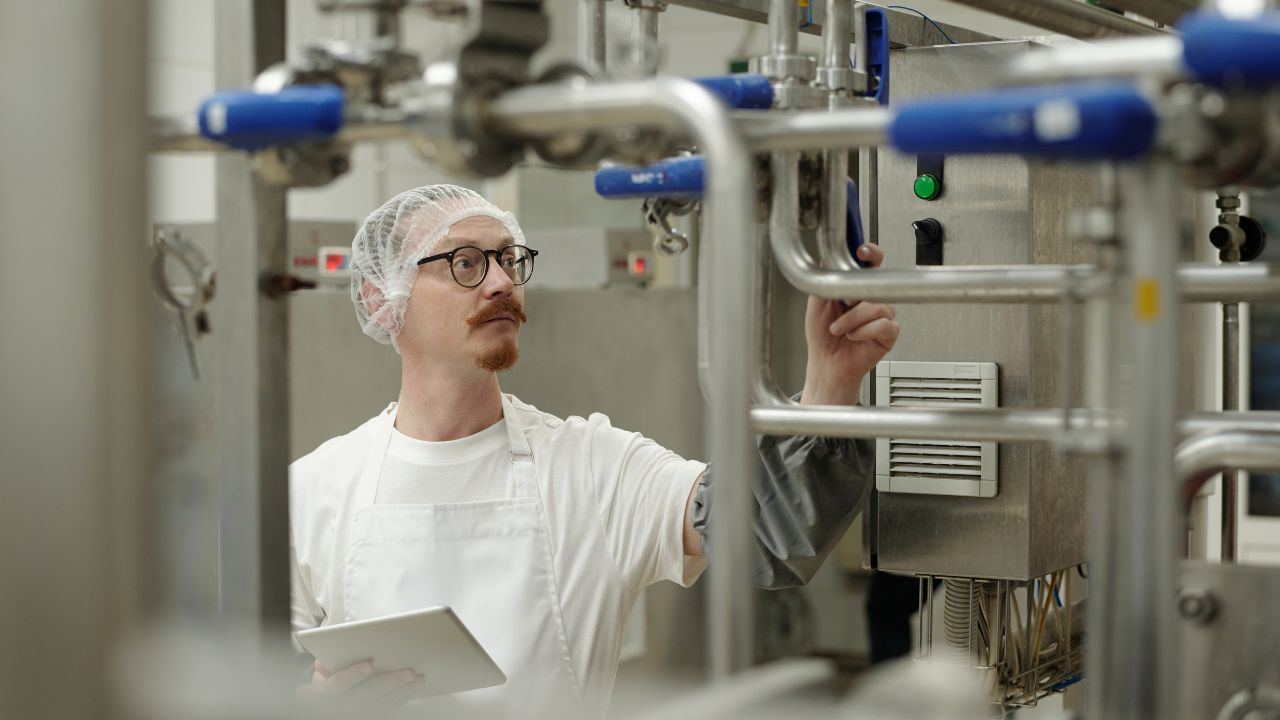
Preventive maintenance directly impacts equipment uptime, with proper maintenance programs reducing unplanned downtime by 60-80%. Mean time between failures (MTBF) varies significantly by machine type, affecting the total cost of ownership and production reliability. Understanding common failure modes enables faster resolution and minimizes production losses.
Key Maintenance Requirements by Machine Type
VFFS Machines:
Daily: Clean sealing jaws, check film tension (2-5 kg), perform seal peel tests
Weekly: Inspect spindle alignment (prevents 80% of tracking problems)
Monthly: Deep clean, replace sealing jaws every 1-2 million bags ($1,000-$2,000)
MTBF: 2,000-4,000 operating hours
Annual maintenance: 40-80 hours
HFFS Machines:
Daily: Clean sealing wheels, verify fin seal and end seal quality
Weekly: Check former alignment, inspect film path, and tension
Daily: Clean pouch guides and sensors, verify seal quality
Weekly: Inspect opening mechanisms, test reject systems
Monthly: Lubricate rotary turret (if applicable)
MTBF: 3,000-6,000 hours (highest of all types)
Annual maintenance: 20-40 hours (lowest for automated systems)
Top 3 Troubleshooting Issues
Film Tracking Problems (VFFS - Causes 80% of Issues):
Solution: Re-center spindle, replace worn bearings ($500-$1,000), verify film tension is 2-5 kg
Prevention: Weekly spindle alignment checks
Seal Failures (All Types - 85-92% Caused by Settings):
Solution: Increase temperature 10-20°C (180-220°C typical), increase pressure 0.5-1 bar, extend dwell time 0.2-0.5 seconds
Prevention: Daily seal peel tests, weekly jaw cleaning
Pouch Jams (Premade Pouch - Most Common):
Solution: Realign guides, clean sensors, and change the pouch lot if defects are present
Prevention: Weekly guide inspection, quality control with the pouch supplier
Making Your Decision: 4 Steps To Selecting The Right Machine
Systematic evaluation of production requirements, cost analysis, product characteristics, and supplier capabilities ensures optimal machine selection. Following this framework reduces the risk of costly mismatches between equipment capabilities and operational needs.
Selection Framework
Calculate Your True Production Requirements
Determine annual volume and required speed (packages per minute)
Count total SKUs and estimate changeover frequency (per day/week)
Consider 3-5 year growth projections and seasonal demand spikes
Decision impact: American-made equipment with local support reduces downtime costs by 30-40%
Finding The Right Bagging Solution
Production volume is key when selecting the right packaging system: under 10 million bags annually, opt for premade pouches or manual systems; for 10-50 million, consider VFFS; and over 50 million, HFFS or high-speed VFFS is ideal. VFFS offers a balance of speed (50-300 ppm) and flexibility for 4-10 SKUs with moderate changeovers, while HFFS provides maximum throughput (300-600+ ppm) but is best for 1-3 SKUs with longer changeovers. Premade pouches offer the fastest changeovers (10-30 minutes) for 10+ SKUs, though with a 45% higher 5-year TCO due to material costs. Material expenses account for 60% of operating costs, making them critical to profitability.
For accurate machine performance, request live demos with your product and packaging, and consult 2-3 customer references. Perform a detailed TCO analysis based on your production specifics. Wolf Packing Machine Company offers free consultations, custom designs, and trade-in programs. With American-made quality, quick parts shipping, and lifetime support, Wolf reduces downtime costs by 30-40%. Contact us today for a free consultation and optimal packaging solution.
Contact Wolf Packing today to schedule your free consultation and discuss which packaging line automation solution delivers optimal performance for your operation.
At Wolf-Packing Machine Company, we believe that the key to success is a commitment to excellence in everything we do. That’s why we use only the highest quality materials and the most advanced technology to create packaging machines that are efficient, reliable, and cost-effective.
What’s new at Wolf Packing?
// <#?php
// /**
// * Exclude Current Posts from the query
// */
// add_action( 'pre_get_posts', function ( $query ) {
// // not an admin page and not the main query
// if ( ! is_admin() && ! $query->is_main_query() ) {
// $query->set( 'post__not_in', array( get_the_ID() ) );
// }
// } );
// ?>
From design through testing, installation and beyond, we work tirelessly to ensure your equipment is running at peak performance and maximizing your application. To learn more about our machines, reach out to set up a free consultation with our in-house experts.
From weigh filling, bagging, wrapping and conveying to capping, labeling, cartoning, case/tray forming, packing and palletizing, we offer packaging solutions for a diverse array of applications.