Key Takeaways
- Choosing the correct number of heads in a multihead weigher directly impacts both speed and accuracy, influencing overall productivity.
- More heads increase the number of combinations, reducing giveaway and improving throughput, especially for high-volume lines.
- Speed and accuracy are a tradeoff; optimizing settings and product compatibility can help balance the two for cost-effective weighing.
- Product characteristics such as size, shape, and moisture content must align with the weigher’s configuration to avoid jams and inaccuracies.
- Regular calibration and maintenance are crucial for maintaining the weigher’s precision, especially in harsh environments with high humidity or vibration.
Choosing the right multihead weigher directly impacts production speed, fill accuracy, and profitability. The wrong choice means giveaway costs, downtime, and product damage. The right choice means consistent precision weighing at the speed your line demands. This guide breaks down the critical decisions, head count, weighing speed, product compatibility, and configuration, so you can match the right weigher to your operation. Whether you run snacks, frozen foods, or hardware, this weigher selection guide gives you the facts to decide fast.
What Is a Multihead Weigher and How Does It Work?
A multihead weigher is a high-speed automated scale that simultaneously weighs product across multiple hoppers and selects the combination that hits the target weight most precisely. It's the standard for precision weighing in food, industrial, and consumer goods packaging lines.
What Are the Key Components of a Multihead Weigher?
Every multihead weigher shares the same core architecture. Product enters through an infeed funnel, travels down a top cone, and disperses across linear vibrators into feed hoppers. From there, it moves into weigh hoppers, where load cells measure each portion. The system selects the best combination and releases the product through a discharge chute into a collecting funnel, then into downstream packaging.
Supporting components include an actuator, touchscreen controller, timing hopper, and main frame. The timing hopper is particularly important, it holds the weighed batch and releases it at the precise moment the packaging machine is ready, preventing gaps and jams on the line.
How Does a Multihead Weigher Ensure Accurate Weighing?
Accuracy comes from the combination algorithm, the brain of the machine. At any given moment, the weigher calculates every possible combination of filled hoppers and selects the one closest to the target weight. More heads mean more combinations, which means tighter fills and less giveaway.
Advanced systems incorporate adaptive combination search, real-time vibration compensation, machine learning recipe libraries, and integrated checkweighing feedback loops that continuously refine performance. Standard accuracy tolerances run ±0.5g to ±3g, depending on product and speed. High-precision models handle quantities as small as 1 gram with resolution to ±0.1g, critical for micro-dosing and high-value products where every fraction of a gram has a cost.
How Do You Choose the Right Number of Heads for a Multihead Weigher?
Head count is the single biggest lever in weigher selection. It determines how many weight combinations the machine can calculate per cycle, and that directly controls both speed and fill accuracy. Match head count to your production volume,e or you'll either overspend or bottleneck your line.
What Are the Benefits of Using More Heads in a Multihead Weigher?
More heads mean more possible combinations per cycle. More combinations mean the machine finds a closer match to the target weight, which reduces giveaway and increases throughput simultaneously. The throughput gains are significant across configurations: a 10-head system produces 60 weighments per minute, a 14-head reaches 90, a 16-head hits 120, a 24-head delivers 180, and a 32-head tops out at 240 weighments per minute.
How Does the Number of Heads Affect Weighing Speed and Accuracy?
Each additional head expands the combination pool that the algorithm searches. A 16-head system, for example, achieves up to 100 weighments per minute across a 10g to 200g range at ±0.5g accuracy, solid performance for most mid-volume food lines. Step up to a 24-head or 32-head system, and you're in high-volume industrial territory, where throughput is the primary constraint, and the machine is built to sustain it continuously.
What Factors Should Be Considered When Selecting the Number of Heads?
Start with your required pack rate. Small-scale operations typically need 20 to 50 packs per minute. High-speed industrial lines often demand over 200. Bucket volume is the next variable, options range from 0.5L to 9L, and choosing the wrong size for your product causes flow problems that no algorithm can compensate for.
Choose a 10-head or 14-head system if you run lower volumes with frequent product changeovers. Choose a 24-head or 32-head system if you run 1,000 or more units per hour with a budget in the $100K to $1M range, and throughput is non-negotiable.
How Does Speed Impact the Performance of Multihead Weighers?
Speed is not a free variable in precision weighing. Push a multihead weigher faster, and something has to give, usually accuracy. Understanding where that tradeoff kicks in, and how to delay it, is essential to getting the most out of your line.
What Is the Relationship Between Speed and Accuracy in Multihead Weighing?
The tradeoff is real and measurable. At 50 weighments per minute, accuracy holds at ±0.5g. At 90 wpm, it slips to ±0.7g. By 130 wpm, you're at ±1.0g, at 170 wp,m it's ±1.5g, and at 210 wp,m accuracy reaches ±2.0g. The machine is cycling faster than the algorithm can find a perfect combination, so it settles for the closest available match.
Advanced combination algorithms and closed-loop control strategies push that ceiling higher, but they don't eliminate the tradeoff. They delay it. For high-value products where giveaway cost is high, running slightly below maximum speed often pays for itself in recovered margin. Choose maximum speed if your product is low-value and the giveaway cost is negligible. Choose a lower cycle rate if you're running a high-value product where every gram of overfill directly hits margin.
How Can You Optimize the Speed of Your Multihead Weigher?
Three mechanical settings have the most direct impact on cycle time. First, adjustable vibration feeder settings control how quickly product reaches the weigh hoppers, tuning these for your specific product's shape and density keeps hoppers consistently charged without overflow or starvation. Second, timing hoppers' smooth discharge between cycles, eliminating the gaps that kill effective throughput.
Third, machine learning recipe libraries store optimized settings for each product you run. Instead of manual recalibration at every changeover, the machine recalls a validated recipe instantly. For operations running multiple SKUs, this alone can recover significant production time across a shift.
How Do Product Characteristics Influence Multihead Weigher Selection?
Product compatibility is not an afterthought in weigher selection, it's the starting point. The wrong configuration for your product causes jams, inaccurate fills, and equipment damage. Match the machine to the product first, then optimize for speed.
What Product Types Are Best Suited for Multihead Weighers?
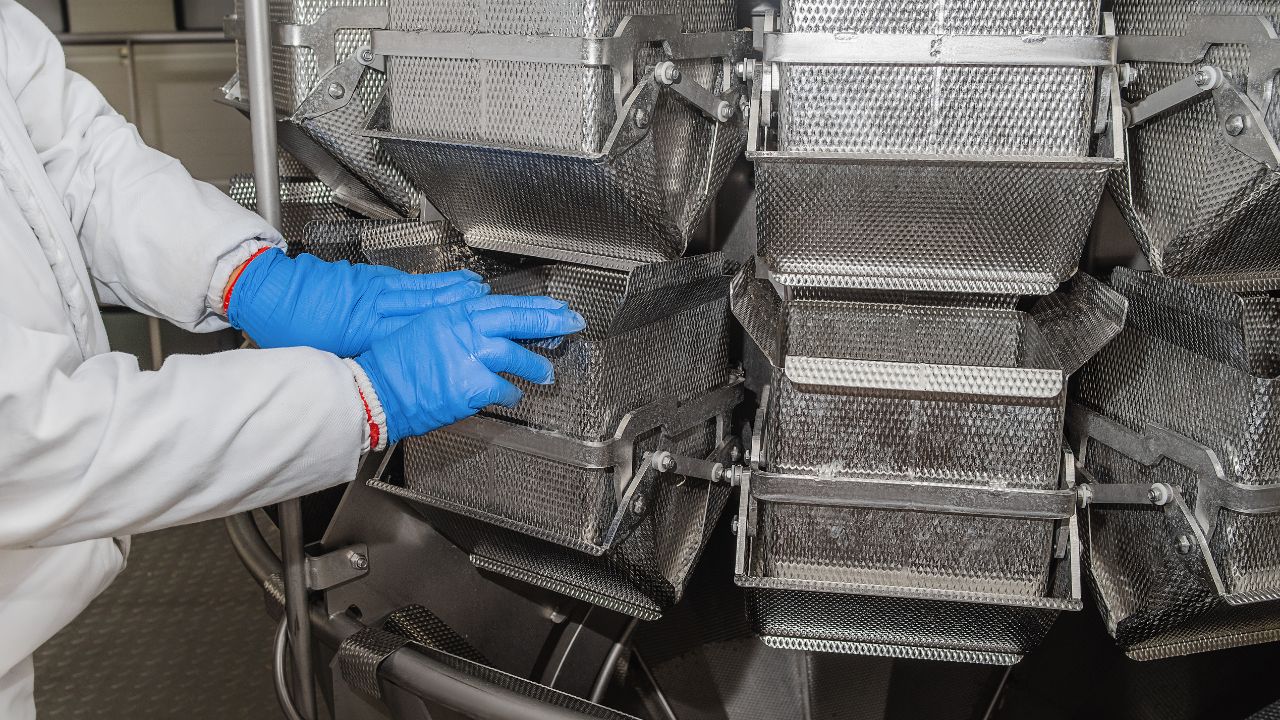
Multihead weighers handle a wide range of products: snacks, dry fruits, confectionery, frozen foods, granules, powders, fresh produce, and small hardware items. Product compatibility comes down to bucket type and feeder configuration. Sticky products need dimpled buckets with a vibratory feeder. Fragile items require a smooth or gentle slope bucket with a vibratory feeder to prevent breakage. Powders and granules run on smooth or vibratory buckets paired with a vibratory or screw feeder. Fresh produce uses dimpled or vibratory buckets with a vibratory feeder. Frozen foods and confectionery both run on dimpled or smooth buckets with vibratory feeders. Hardware uses smooth buckets with a vibratory feeder.
How Does Product Size, Shape, and Density Affect Weigher Choice?
Four intrinsic properties drive configuration decisions: flowability, density, particle size uniformity, and moisture content. High moisture causes stickiness and adhesion inside hoppers. Inconsistent particle size causes bridging and uneven distribution across heads, both kill accuracy.
For sticky or wet products, dimpled buckets are the solution. The textured surface reduces contact area, preventing the product from adhering and ensuring clean discharge. For dry, free-flowing products, smooth buckets are sufficient. The accuracy difference is meaningful: uniform, free-flowing products can achieve ±0.1g tolerance, while sticky or irregular products realistically land around ±1.5g.
Choose dimpled buckets if your product is sticky, wet, or high-moisture. Choose smooth buckets if your product is dry, free-flowing, and uniform in size.
How Can Packaging Requirements Impact the Weigher Selection Process?
Discharge chute configuration must match your downstream packaging format, bags, trays, and pouches each require different geometry for consistent product transfer. Beyond chute design, the industry environment determines material and protection requirements.
Food and pharmaceutical lines require SS304 or SS316 stainless steel construction with IP65 or IP67 ratings to withstand washdown without corrosion or electrical failure. GMP compliance adds another layer: smooth surfaces, tool-less disassembly, and modular components are required to meet sanitation standards and minimize cleaning downtime between runs.
What Are the Key Advantages of Multihead Weighers Over Other Weighing Systems?
Multihead weighers outperform single-head and linear weighing systems on speed, accuracy, and cost efficiency. The combination logic alone separates them from every alternative, and that gap compounds over time in the form of recovered margin and regulatory protection.
Why Are Multihead Weighers More Efficient Than Other Systems?
The core efficiency advantage is giveaway reduction. Every gram of product added beyond the target weight is product you're giving away for free. Reducing average giveaway from 2g to 0.5g per pack yields up to $25,000 in annual cost savings per line, and that figure scales with pack rate and product value.
Unchecked giveaway doesn't just erode margin on individual packs. It compounds across every shift, every SKU, and every line running simultaneously. Integrated reject systems add a second layer of protection, automatically pulling off-weight packs before they reach the consumer and before they become a compliance issue.
How Can Multihead Weighers Improve Product Quality and Consistency?
Consistency isn't just a quality metric, it's a legal requirement. NIST Handbook 133 sets the Maximum Allowable Variations that every packager must meet. For products labeled at 500g to 1,000g, the MAV is 14g. For 1kg to 10kg, it's 1.5% of the labeled weight. Above 10kg, it drops to 1.0%. Multihead weighers, properly calibrated and monitored, keep fills well within these thresholds consistently.
Statistical process control through fill weight control charts makes that consistency visible in real time. A stable line running a 500g target should show all sample weights clustered near the mean, with no points breaching the upper or lower control limits set at ±3 standard deviations. When a point breaks that boundary, the system flags it immediately, before a bad run becomes a costly one.
What Maintenance and Calibration Considerations Should Be Made for Multihead Weighers?
A multihead weigher is only as accurate as its last calibration. Mechanical precision degrades over time, and environmental conditions accelerate that drift. A consistent maintenance schedule is what separates a line that performs to spec from one that quietly bleeds giveaway and compliance risk.
How Often Should Multihead Weighers Be Calibrated?
For standard operating conditions, annual calibration is the baseline. Harsh environments, high cycling frequency, constant vibration, moisture exposure, or chemical contact, require calibration every 3 to 6 months, or before and after critical production runs where accuracy directly affects cost or compliance.
Food and pharmaceutical operations have no flexibility here. Regulatory and quality standards in both industries mandate calibration every 3 to 6 months, regardless of operating conditions. Build it into the production schedule as a fixed interval, not a reactive response to drift. Choose annual calibration if you run standard dry products in a stable environment. Choose a 3 to 6 month schedule if you operate in food, pharmaceutical, or any harsh environment with moisture, vibration, or chemical exposure.
What Regular Maintenance Tasks Should Operators Follow?
Environmental factors cause more calibration drift than mechanical wear in most facilities. Temperature fluctuations cause thermal expansion and contraction in load cell components, shifting the zero balance without any visible sign of malfunction. High humidity drives moisture into electronics and causes condensation that introduces measurement error. Static electricity, especially common with powders and granules, produces erratic load cell readings that are easy to misdiagnose as mechanical failure.
The practical response is to operate weighing systems in stable, controlled environments and treat regular calibration as the primary compensation mechanism for cumulative drift. For food-grade lines, EHEDG-certified load cells meet the additional requirement of withstanding rigorous cleaning protocols without compromising measurement integrity, a non-negotiable spec for operations running washdown cycles between production runs.
Ready to Build a More Profitable Packaging Line?
Weigher selection comes down to four decisions: head count, speed tolerance, product compatibility, and maintenance discipline. Get those right, and your line runs tighter fills, less giveaway, and stronger compliance, consistently. Get them wrong, and the costs compound quietly across every shift.
At Wolf Packing, we engineer custom packaging solutions built around your product, your volume, and your margins. Whether you're scaling up, replacing aging equipment, or launching a new line, we'll help you identify the right configuration and back it with ongoing support. Reach out today to talk through your application, we'll help you find the right fit.