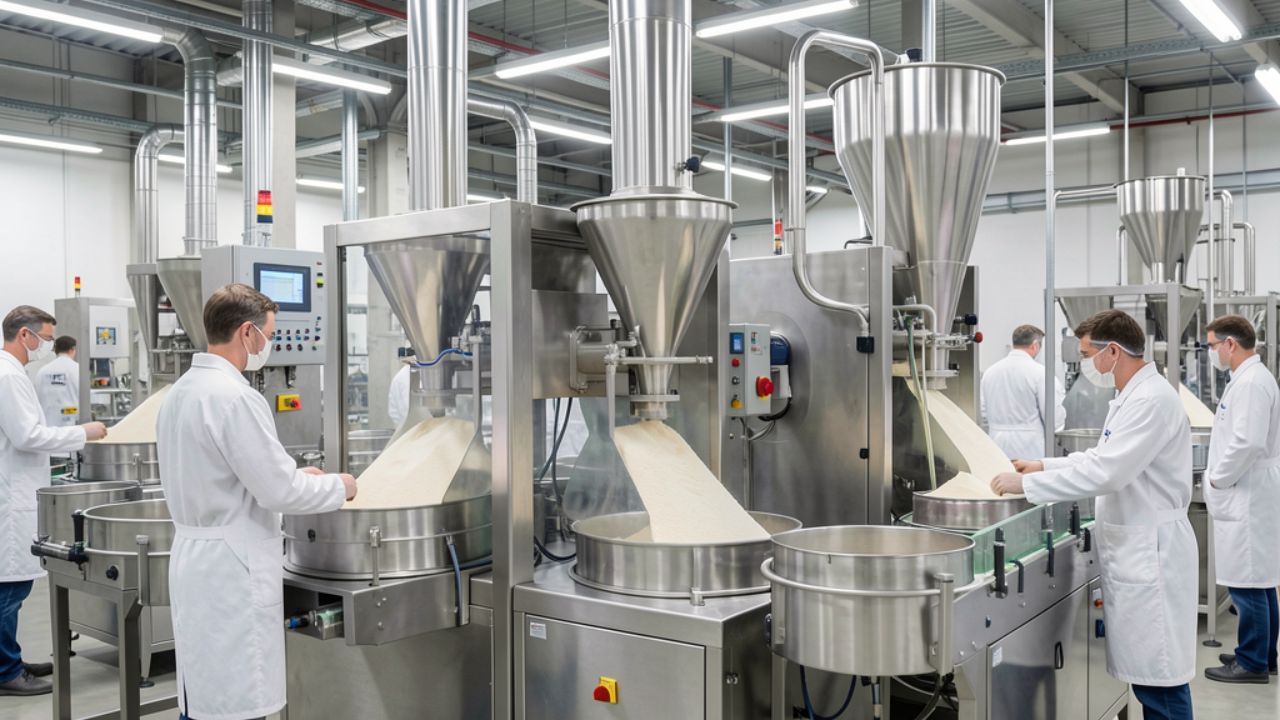
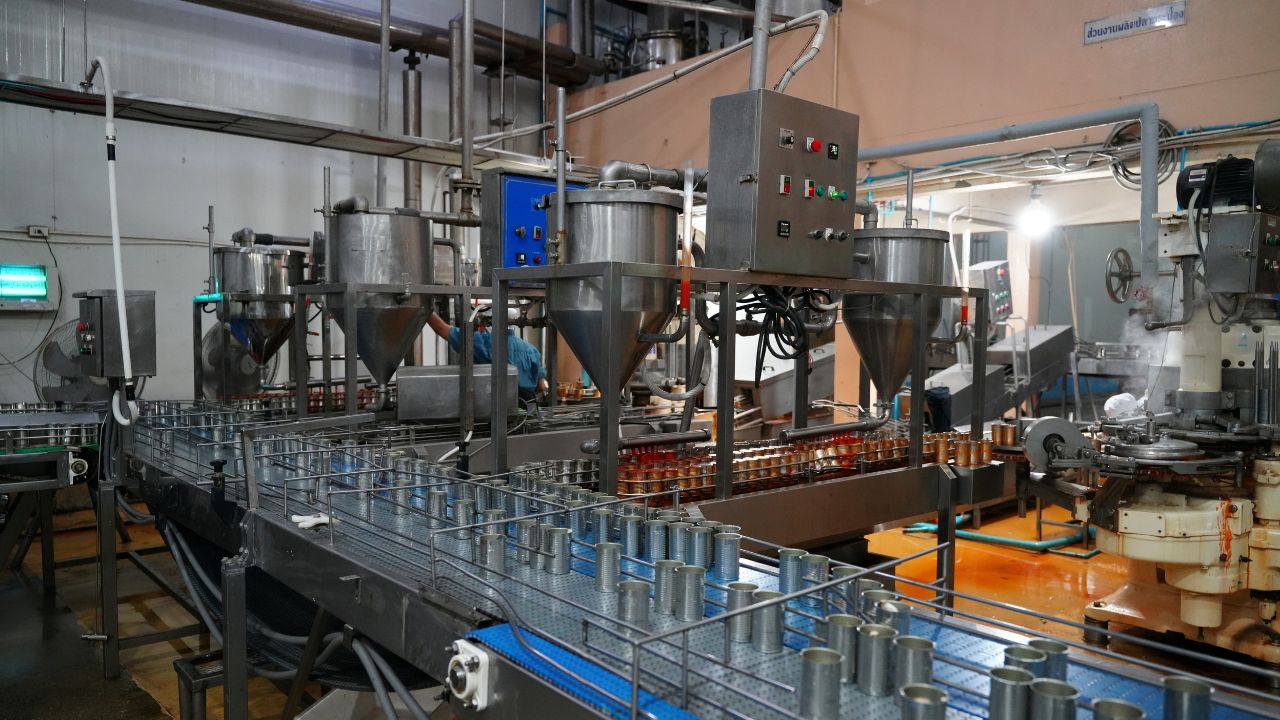
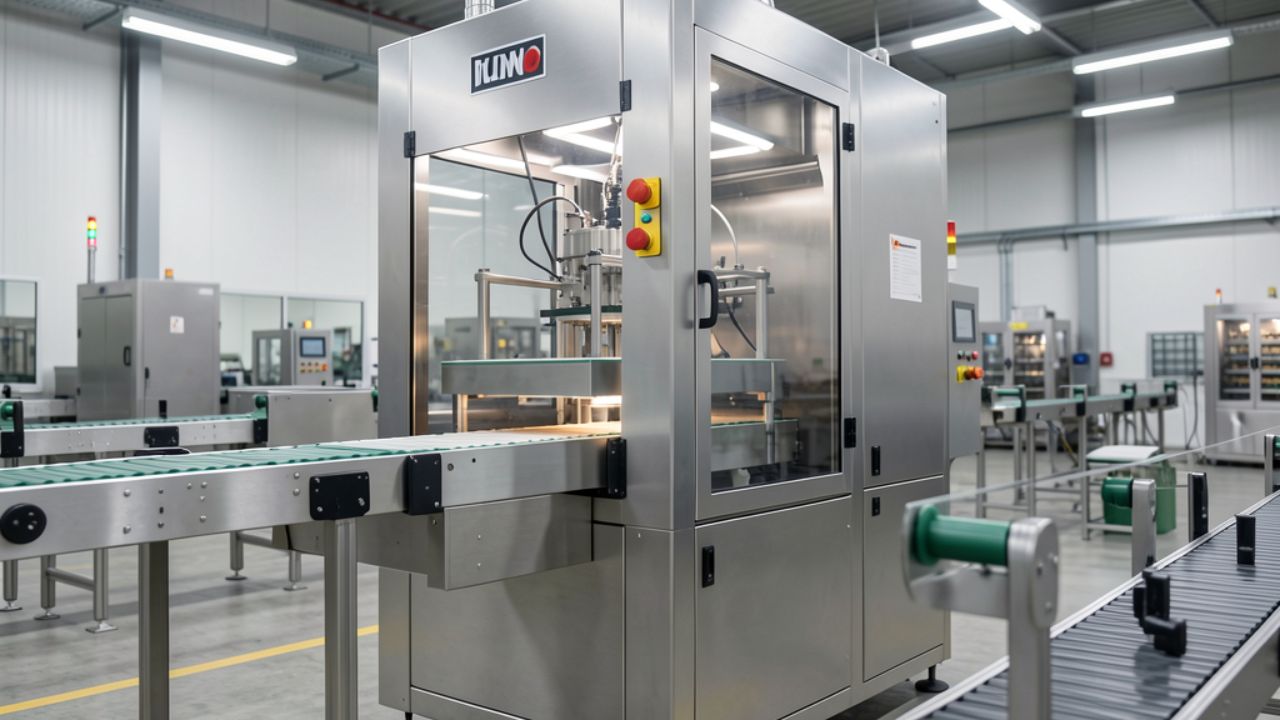
Speed: Auger fillers are the fastest for powder dispensing, with linear systems at 40 CPM and rotary systems up to 150 CPM.
Accuracy: Standard systems offer ±0.5% to ±1% accuracy, but advanced systems with density controls or net-weight feedback can achieve up to 0.15% giveaway.
Labor Savings: Servo motors reduce labor costs by 35%, simplifying operation and reducing maintenance needs.
Technology Choice: Auger fillers are ideal for density-stable powders, while net-weight fillers are better for high-value or variable-density powders.
Auger filler machines use volumetric metering to dispense powders with speed and precision. A rotating spiral screw, the auger, transports product from a bulk hopper into containers below. Fill volume is controlled by counting auger rotations, with modern servo motors managing this process to eliminate manual adjustments and achieve accuracy within ±0.5% for density-stable powders.
The technology excels where speed matters most. Linear systems hit 40 containers per minute (CPM), while rotary configurations reach 150 CPM, making auger fillers the fastest option forpowder packaging equipment. Advanced systems integrate net-weight feedback loops, tightening accuracy to 0.15% giveaway and delivering rapid ROI through material savings.
This guide examines how auger fillers work, when they outperform alternatives like net-weight and cup fillers, and how to select the right configuration for your powder packaging operation.
What Are Auger Filler Machines And How Do They Work?
Auger fillers dispense powder by rotation count. The auger sits inside a hopper and turns a precise number of times per fill. Each rotation moves a fixed volume of product through the discharge nozzle into the container. For free-flowing powders like salt or milk powder, this simple mechanism delivers consistent results. For clumping products like flour, an agitator bar rotates inside the hopper to break up clumps and maintain a steady flow to the auger flights.
Servo motors have replaced older clutch-and-brake systems in modern powder filling machines. This upgrade eliminates coasting and slippage, improving fill-to-fill consistency while reducing maintenance. The servo controller counts rotations with precision, simplifying the operator interface and cutting dependency on skilled labor by up to 35%.
Key Components of an Auger Filler Machine
Component
Function
Technical Note
Hopper
Holds bulk powder supply
Requires venting to equalize pressure, especially when the product has become aerated during conveying
Auger (Spiral Screw)
Transports product via rotation
Straight auger design for consistent volumetric metering
Motor
Controls auger rotation speed
Servo motors are increasingly preferred over clutch/brake for greater accuracy and reduced maintenance
Agitator/Stirring Bar
Prevents clumping in non-free-flowing powders
Essential for products like flour or cocoa powder
Discharge Nozzle
Directs product into the container
Often equipped with dust extraction via a vacuum port
Control System
Manages rotation count and speed
Simplifies user interface in servo-driven systems, reducing dependency on skilled labor
Horizontal Screw Feeder (Optional)
Redensifies the product before filling
Mounted over the hopper to ensure consistent head pressure
Why Are Auger Filler Machines Ideal For Powder Packaging?
Auger fillers deliver the fastest throughput for powders while maintaining tight accuracy if product density stays consistent. Standard systems achieve ±0.5% to ±1% accuracy, sufficient for most medium-value products. Optimized configurations with density controls hit ±0.25%, while hybrid systems that add a checkweigher feedback loop reach 0.15% giveaway by adjusting fill parameters in real-time.
Density stability determines performance. Temperature swings, humidity changes, and aeration all alter powder bulk density, causing volumetric fills to drift. The solution: a horizontal screw feeder mounted above the hopper re-compacts product before it reaches the auger, ensuring consistent head pressure. Hopper venting equalizes pressure, preventing aeration-related errors. For high-value powders, these controls reduce giveaway to 0.05–0.07 pounds with standard deviation below 0.15 pounds, cutting rejected lot risk to under 0.1%.
Precision Performance Metrics:
Metric
Performance Range
Conditions
Accuracy (Standard)
±0.5% to ±1%
Highly affected by powder density consistency
Accuracy (Optimized)
Up to ±0.25%
Achievable under ideal conditions with consistent product density and advanced tooling
Accuracy (Net Weight Feedback)
As low as 0.15% giveaway
Achieved by advanced systems integrating a checkweigher for real-time feedback
Speed (Linear)
40 CPM
Standard linear configuration
Speed (Rotary/Twin)
Up to 150 CPM
High-speed rotary systems and twin-head fillers
Labor Savings
Up to 35%
Achieved through automation and reduced operator adjustments
Types of Powders Auger Filler Machines Can Handle
Powder Type
Handling Characteristics
Adjustment/Configuration Needed
Examples
Free-Flowing, Density-Stable
✓ Best performance✓ Highest accuracy
Minimal - simple setup sufficient
Milk powder, protein powder, granulated sugar, salt
Non-Free-Flowing
⚠ Tends to clump⚠ Requires agitation
Stirring bar/agitator within the hopper is essential
Flour, cocoa powder
Fine Powders (Dusty)
⚠ Airborne dispersion risk⚠ Requires containment
Dust extraction via the vacuum port at the filler funnel
Spices, fine seasoning powders
Seasonings & Starch
✓ Good performance
Standard configuration
Seasoning powder, starch
Coffee Grounds
✓ Suitable
May require density control for consistency
Coffee grounds
What Are The Key Advantages Of Using Auger Filler Machines For Powder Packaging?
Auger fillers win on speed and cost. Linear systems run 40 CPM standard, while rotary and twin-head configurations push 150 CPM, the fastest powder filling available. This speed advantage matters most for medium-value products where the lower equipment cost compared to net-weight fillers delivers better ROI. Servo motors cut labor costs 35% by eliminating constant operator adjustments, and the simplified interface reduces training requirements.
How Auger Filler Machines Improve Packaging Efficiency:
Speed Leadership: Auger fillers are the "King of speed" in powder filling, linear systems hit 40 CPM, rotary/twin systems reach 150 CPM
Labor Cost Reduction: Servo-driven auger fillers reduce labor costs by up to 35% through automation
Simplified Operation: Servo technology simplifies the user interface, reducing dependency on highly skilled labor
Lower Initial Investment: Auger fillers have lower equipment investment compared to net-weight fillers
Best Cost-Performance Ratio: For medium-value products, auger fillers offer an optimal balance between speed, accuracy, and cost
Material savings come from precision control. Standard accuracy of ±0.5% to ±1% prevents the gross overfill common in manual scooping. Optimized systems hit ±0.25%, while checkweigher integration tightens control to 0.15% giveaway. For high-value powders, this precision cuts average giveaway to 0.05–0.07 pounds with standard deviation under 0.15 pounds, reducing rejected lots to less than 0.1%.
How Auger Filler Machines Reduce Product Waste:
Precision Volumetric Control: Standard systems achieve ±0.5% to ±1% accuracy; optimized systems reach ±0.25% accuracy
Net-Weight Feedback Integration: Advanced systems with integrated checkweigher achieve giveaway as low as 0.15% through real-time adjustment
Consistent Fill Targets: For high-value products, systems maintain average giveaway of 0.05–0.07 pounds, standard deviation <0.15 pounds, and rejected lot risk <0.1%
Density Management Features: Horizontal screw feeder re-densifies product for consistent head pressure; hopper venting equalizes pressure to prevent aeration-related inaccuracies
What Types Of Industries Benefit From Auger Filler Machines?
Auger fillers serve three primary sectors: food manufacturing, pharmaceuticals, and cosmetics. Each industry values different performance characteristics, but all benefit from volumetric precision and high-speed operation. Food and beverage manufacturers prioritize speed and cost-effectiveness for medium-value powders like milk powder, protein supplements, and spices. Pharmaceutical operations demand tighter accuracy for dosage control, often requiring hybrid systems with net-weight feedback. Cosmetic manufacturers need dust containment for fine powders and consistent metering for product presentation.
Food & Beverage Industry: Food manufacturers use auger fillers for density-stable powders, milk powder, protein powder, seasoning blends, starch, coffee grounds, and spices. These products achieve best results with standard powder dosing systems, where speed and cost-performance ratio matter more than absolute accuracy. Medium-value food powders suit auger technology because the lower equipment investment compared to net-weight fillers delivers faster ROI while maintaining ±0.5% to ±1% accuracy. Integration with vertical form fill seal systems creates complete packaging lines that maximize throughput.
Pharmaceutical Industry: Pharmaceutical applications require dosage precision. Auger fillers meet regulatory accuracy requirements for many pharmaceutical powders, but high-value active pharmaceutical ingredients (APIs), especially dusty, fluffy, or poor-flowing materials, often perform better with net-weight fillers. The density-independent weighing of gravimetric systems eliminates variability from temperature or humidity changes, critical for pharmaceutical compliance. For less demanding pharmaceutical powders, servo-driven auger systems with checkweigher feedback deliver pharmaceutical-grade accuracy at lower cost.
Cosmetic Industry: Cosmetic powders, makeup, skincare products, and fine mineral powders benefit from auger precision and dust control. Volumetric metering ensures consistent product presentation, critical for consumer-facing products. Fine cosmetic powders generate airborne dust, making integrated vacuum extraction at the discharge nozzle essential. The combination of precision metering and dust containment makes auger fillers ideal for cosmetic powder packaging where product consistency and cleanliness drive brand reputation.
How Do Auger Filler Machines Compare To Other Filling Machines?
Auger fillers compete with two alternatives: net-weight fillers (gravimetric) and volumetric cup fillers. The choice hinges on product density stability and value. If powder density stays consistent across production runs, auger fillers deliver the best speed-to-cost ratio. If density varies with temperature, humidity, or aeration, net-weight fillers prevent accuracy drift. For free-flowing granules rather than powders, cup fillers offer the simplest, lowest-cost option.
The critical decision point: auger accuracy depends entirely on density consistency. A powder that measures 500 grams per liter at 20°C might measure 480 grams per liter at 30°C. The auger still dispenses the same volume, but the fill weight drops 4%. This is why high-value or variable-density powders justify net-weight fillers despite higher cost. The most accurate powder packaging machines solve this by integrating checkweigher feedback, creating hybrids that capture auger speed with gravimetric precision.
Auger Fillers vs. Net-Weight Fillers (Gravimetric)
Feature
Auger Filler (Volumetric)
Net Weight Filler (Gravimetric)
Decision Criteria
Core Principle
Volumetric Metering (Auger Rotations)
Real-Time Weighing (Load Cells)
-
Accuracy
Good: ±0.5%-1% (density-dependent)
Excellent: ±0.1%-0.5% (density-independent)
⚠ Accuracy degrades if powder density changes due to temperature, humidity, aeration
Speed
Very High Speed ("King of speed")
Medium-High Speed (slightly slower due to weighing feedback)
✓ Choose auger for maximum throughput priority
Cost
Lower equipment investment
Higher equipment investment
✓ Choose auger for medium-value products; net-weight for high-value
Best For
Density-stable powders (Milk powder, Protein powder)
High-value, dusty, fluffy, or poor-flowing materials (Flour, Pharmaceuticals)
❗ For variable-density powders, net-weight filler is often a superior choice
Hybrid Option
✓ Can integrate net-weight feedback loop
-
Advanced auger systems with checkweigher achieve 0.15% giveaway [7]
Auger Fillers vs. Volumetric Cup Fillers
Feature
Auger Filler
Volumetric Cup Filler
Principle
Screw-based volumetric metering
Cup-based volumetric metering
Accuracy
Good (±0.5%-1%) for powders
Good, best for free-flowing granules [9]
Speed
High Speed (40-150 CPM)
High Speed, gentle for free-flowing products [10]
Cost
Lower initial investment
Lowest initial investment [9]
Product Suitability
Powders, some granules
Free-flowing granules (Rice, Seeds) [9]
Best For
Fine to medium powders requiring precision
Uniform, free-flowing granular products
When Auger Filler is the BEST Choice: Product has stable density across production runs; medium-value products where cost-performance balance is critical; high speed is priority (40-150 CPM required); lower initial capital investment is needed; powders (not granules) are the primary product type.
When Net-Weight Filler is a BETTER Choice: Product density varies with temperature, humidity, or aeration; high-value products where material savings justify higher equipment cost; dusty, fluffy, or poor-flowing materials like flour; highest accuracy required (±0.1%-0.5%) for regulatory or quality reasons.
How To Choose The Right Auger Filler Machine For Your Packaging Needs?
Machine selection starts with product characteristics, then matches speed requirements to configuration. Density consistency determines whether a basic auger system suffices or if net-weight feedback is essential. Flow characteristics, free-flowing versus clumping, dictate agitator requirements. Product value and required accuracy level guide motor technology choice and whether to integrate checkweigher feedback. For high-volume operations above 80 CPM, servo motors and automated density control become critical for maintaining accuracy at speed.
Factors to Consider When Selecting an Auger Filler Machine:
Product Density Consistency: Most critical factor for accuracy. If density changes with temperature, humidity, or aeration, consider a horizontal screw feeder for re-densification or net-weight feedback integration.
Powder Flow Characteristics: Free-flowing powders need a simple setup; non-free-flowing powders require a stirring bar/agitator; dusty powders require a dust extraction system.
Motor Technology: Servo motors cost more upfront but deliver greater accuracy, reduced maintenance, and 35% labor savings versus clutch/brake systems prone to coasting and slippage.
Hygienic Design Requirements: Food applications require HACCP-compliant design, 3A Sanitary Standards compliance, stainless steel construction, tool-less disassembly for cleaning, and smooth surfaces to prevent contamination.
Environmental Control: Hopper venting is essential for aerated products; dust containment is required for fine powders.
Production volume determines configuration complexity. Low-volume operations under 40 CPM can use linear configurations with standard motors and basic density control. Medium-volume lines (40-80 CPM) benefit from servo-driven systems and horizontal screw feeders.
High-volume operations above 80 CPM demand rotary or twin-head configurations, servo motors, net-weight feedback, and automated density control to maintain 0.15% giveaway at 150 CPM speeds. Systems can integrate with pre-made pouch bagging machines for complete packaging solutions.
How Production Volume and Speed Affect Machine Selection:
Low-Volume Operations (Under 40 CPM): Linear auger filler configuration hits 40 CPM with standard motor, basic density control, and lower capital investment priority.
Medium-Volume Operations (40-80 CPM): Linear or rotary configuration based on space; servo-driven system for consistency; horizontal screw feeder recommended for density control.
High-Volume Operations (80-150+ CPM): Rotary or twin-head configuration reaches 150 CPM; servo motors essential for accuracy at speed; net-weight feedback integration achieves 0.15% giveaway; automated density control critical; predictive maintenance systems maximize uptime.
Speed vs. Accuracy Trade-off: For high-value products targeting extremely low giveaway (0.05-0.07 lbs) with <0.15 lbs standard deviation, sacrifice some speed to maintain accuracy.
What Are The Potential Challenges Of Using Auger Filler Machines?
Auger filler performance can be affected by density variations caused by temperature, humidity, or aeration. This leads to inconsistent weight despite consistent volume. Solutions include using a horizontal screw feeder to re-densify the product, hopper venting to equalize pressure, or integrating net-weight feedback for real-time accuracy adjustments.
Troubleshooting Common Problems:
Inaccurate Fills: Caused by density changes. Fix by adding a screw feeder, venting, or upgrading to net-weight feedback.
Clogging: Agitate non-free-flowing powders with a stirring bar to prevent clumping.
Coasting/Slippage: Replace clutch/brake systems with servo motors for improved accuracy.
Dust Dispersion: Use a dust extraction system to manage airborne fine powders.
Inconsistent Weights: Regularly calibrate to maintain accuracy.
Maintenance Tasks:
Daily: Clean parts, verify hopper venting, and check dust systems.
Weekly: Calibrate, inspect the agitator, and clean nozzles.
Monthly: Comprehensive calibration, inspect servo motors, and lubricate components.
Quarterly: Deep clean for food-grade applications, inspect auger wear, and check venting.
Annual: Replace worn parts and run diagnostics.
Priority: Focus on maintaining consistent product density, especially for density control equipment like the screw feeder and hopper venting.
Optimize Your Powder Packaging Operation With Auger Filler Machines
Auger filler machines offer the fastest and most cost-effective solution for powder packaging, especially for density-stable products. With linear systems reaching 40 CPM and rotary configurations up to 150 CPM, they excel in high-speed operations. Standard auger fillers provide ±0.5% to ±1% accuracy, which is sufficient for medium-value products, while optimized systems can achieve ±0.25% accuracy, and hybrid systems with net-weight feedback reach as low as 0.15% giveaway. Servo motors reduce labor costs by up to 35%, simplifying operations and enhancing efficiency. Auger fillers are ideal for food manufacturing applications like milk powder, protein supplements, seasonings, and coffee, where speed and cost-effectiveness are key.
However, for high-value, poor-flowing, or dusty powders, net-weight fillers may be more suitable due to their density independence. The best auger systems combine volumetric and gravimetric precision, offering a balance of speed and accuracy. For optimal ROI, prioritize servo-driven systems with density control, and consider net-weight feedback for high-value products.
Ready to optimize your powder packaging operation? Contact Wolf Packing's automation specialists to discuss auger filler configurations that match your product characteristics and production targets.
At Wolf-Packing Machine Company, we believe that the key to success is a commitment to excellence in everything we do. That’s why we use only the highest quality materials and the most advanced technology to create packaging machines that are efficient, reliable, and cost-effective.
What’s new at Wolf Packing?
// <#?php
// /**
// * Exclude Current Posts from the query
// */
// add_action( 'pre_get_posts', function ( $query ) {
// // not an admin page and not the main query
// if ( ! is_admin() && ! $query->is_main_query() ) {
// $query->set( 'post__not_in', array( get_the_ID() ) );
// }
// } );
// ?>
From design through testing, installation and beyond, we work tirelessly to ensure your equipment is running at peak performance and maximizing your application. To learn more about our machines, reach out to set up a free consultation with our in-house experts.
From weigh filling, bagging, wrapping and conveying to capping, labeling, cartoning, case/tray forming, packing and palletizing, we offer packaging solutions for a diverse array of applications.