Key Takeaways:
- High-speed flow wrappers achieve up to 350 packages per minute through multi-axis servo motor control and precise synchronization of all moving parts.
- Line balance is critical—upstream feeding and downstream case packing must match wrapper capacity, or the slowest component limits total throughput.
- Features like "no product, no bag" and "misplaced product detection" minimize film waste and machine downtime at elevated speeds.
- Film-to-product registration accuracy and seal integrity must be maintained at high speeds through electronic synchronization and on-the-fly adjustments.
- Each major component (infeed conveyor, film feed, sealing jaws) requires separate servo motor control coordinated by a central motion controller.
Flow wrappers, also known as horizontal form-fill-seal (HFFS) machines, are used to package solid products in continuous motion. Speed determines line capacity, but maximum mechanical speed rarely equals sustainable throughput. Understanding what limits speed and how to match wrapper performance to line requirements separates efficient operations from bottlenecked facilities.
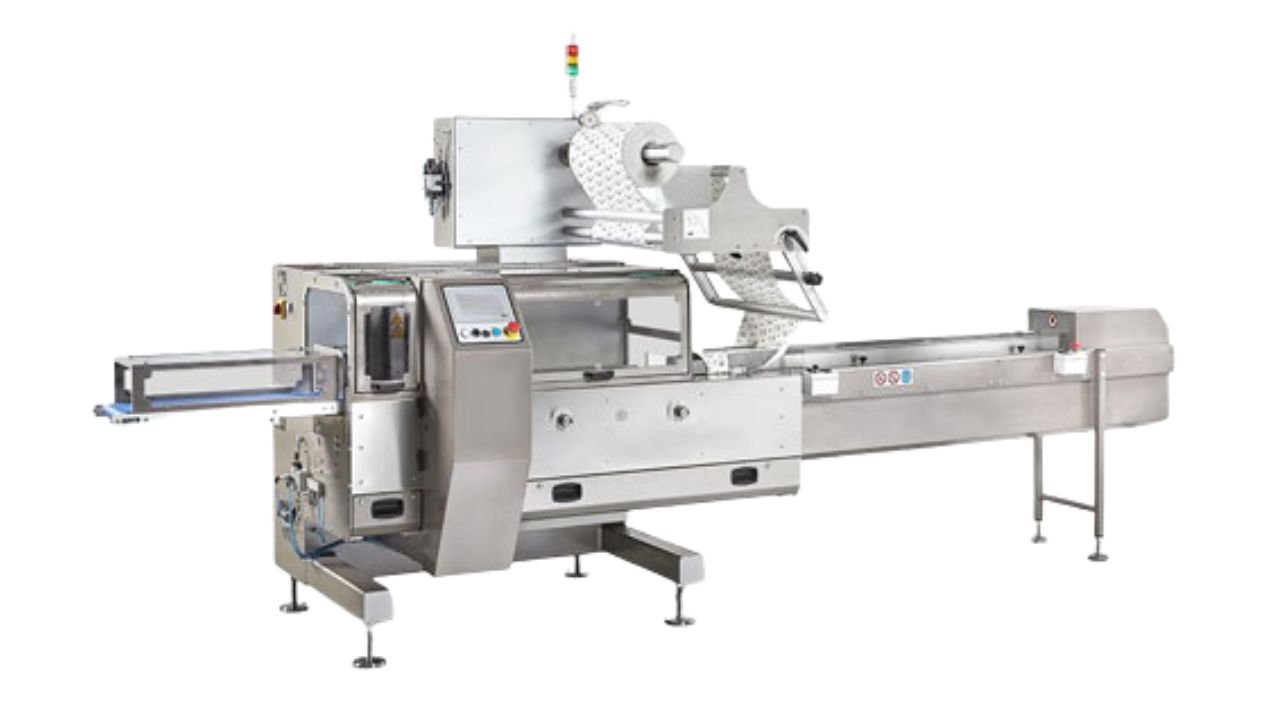
High-speed flow wrappers can achieve speeds of up to 350 packages per minute. The key to high performance is the precise synchronization of the product infeed, film feed, and sealing/cutting operations. This article explains how to identify speed constraints, optimize wrapper settings, and integrate the entire line for maximum efficiency.
What does flow wrapper speed mean in modern packaging operations?
Flow wrapper speed measures packages produced per minute. Rated speed differs from actual throughput due to changeovers, adjustments, and upstream variation. Understanding these differences sets realistic targets.
How is "packages per minute" calculated on a flow wrapping machine?
Packages per minute (PPM) equals complete wrap cycles executed in 60 seconds. A wrapper completing one cycle every 0.5 seconds produces 120 PPM. Cycle time includes product infeed, film advance, sealing, and cutting. The slowest operation determines maximum speed.
How do package pitch, product length, and film index determine achievable speed?
Package pitch is the centre-to-centre distance between products on the infeed conveyor. A tighter pitch allows higher throughput if the wrapper can keep pace. Film index is how far film advances per cycle—it must equal product length plus seal width plus clearance. A longer index means more time per cycle.
How does mechanical speed differ from effective throughput and OEE?
Mechanical speed is peak capability under ideal conditions. Effective throughput accounts for all production losses. A wrapper rated at 200 PPM might deliver 140-160 PPM average. Overall Equipment Effectiveness (OEE) quantifies this gap through availability, performance rate, and quality yield metrics.
What factors determine the maximum speed of a flow wrapper?
Multiple elements constrain flow wrapper speed. Product characteristics, sealing requirements, film behaviour, and mechanical design all play roles. Identifying the primary bottleneck enables targeted improvement.
How do product size, texture, and fragility influence speed limits?
Large products need more time to position correctly. Heavy items require gentler acceleration. Sticky products adhere to conveyors, causing spacing irregularities. Soft products compress under film tension. Fragile items require reduced speeds to prevent breakage. Each product type has an optimal speed range.
How do sealing temperature, pressure, and dwell time affect cycles per minute?
Seal time directly limits cycle rate. If sealing requires 0.3 seconds, the maximum speed is roughly 200 PPM. Thicker films need longer dwell times. The combination of temperature, pressure, and dwell time defines the sealing window. Operating outside this window causes seal failures.
How do film type, thickness, and friction characteristics impact speed stability?
Film stiffness affects tracking through the machine. Thin films conform well but wrinkle easily at high speeds. Film thickness affects seal time. Friction between film layers causes drag, affecting film tension. Static buildup causes registration errors. Film selection directly impacts achievable speed.
How do servo drives, jaw motion, and machine design shape acceleration profiles?
Modern flow wrappers rely on multi-axis servo motor control and electronic synchronization to achieve high speeds and precision—technology shared with today's vertical form fill seal machine systems. Each major component—infeed conveyor, film feed, and sealing jaws—is controlled by a separate servo motor. Movements are precisely coordinated by a central motion controller, allowing on-the-fly adjustments.
How does flow wrapper speed influence production line efficiency?
Flow wrapper speed affects the entire packaging line. Line balance—the synchronization of the flow wrapper with upstream equipment to ensure smooth and continuous product flow—determines overall system capacity.
How does upstream feeding or loading set the wrapper's operating ceiling?
The wrapper cannot run faster than the products arrive. Manual loading limits speed to 30-60 PPM. Automated infeed enables 150-300 PPM. Irregular spacing forces the wrapper to slow down or stop. Upstream equipment must deliver products at consistent intervals matching wrapper speed.
How does downstream case packing or accumulation constrain wrapper throughput?
Downstream equipment must clear packages fast enough to prevent a backlog. Accumulation tables provide buffer capacity during downstream interruptions. Without accumulation, any downstream stop forces immediate wrapper shutdown, reducing OEE.
How does wrapper speed affect line balancing and system bottlenecks?
The slowest equipment sets the overall line capacity. Balancing requires matching all equipment capacities. Proper line design ensures the wrapper's target speed aligns with upstream feeding and downstream handling capabilities.
What are the most common causes of speed loss on flow wrappers?
Speed loss comes from film handling problems, mechanical issues, and product complications. Features such as "no product, no bag" and "misplaced product detection" help minimize film waste and machine downtime.
Why do film misregistration, tracking faults, or web breaks occur at speed?
Film-to-product registration is the accuracy with which printed film aligns with the product. At high speeds, small registration errors compound quickly. Web breaks occur when film tension exceeds film strength. Each break costs 2-5 minutes for rethreading.
Why do cutting errors, jaw jams, or product misfeeds reduce performance?
Cutting errors occur when the knife doesn't fully sever the film. Dull blades slow the cutting cycle. Jaw jams happen when debris prevents proper jaw closure. Product misfeeds occur when items arrive askew. These stops accumulate into significant throughput loss.
Why do micro-stops, adjustments, or inconsistent product spacing lower output?
Micro-stops are brief interruptions lasting 5-30 seconds. They can consume 10-20% of the shift time when frequent. Inconsistent product spacing creates timing conflicts. Variable spacing means variable waiting, reducing average speed below the mechanical maximum.
How do product and application characteristics affect ideal flow wrapper speed?
Different products demand different handling approaches. The wrapper must be configured to match product needs, often requiring speed reductions.
How do sticky, soft, or irregular items change wrapper infeed requirements?
Sticky products adhere to conveyor surfaces, requiring specialized release coatings. Products must be spaced to prevent contact, reducing packages per minute. Soft products compress under film tension, requiring reduced film tension and slower speeds. Irregular shapes need vision systems that add cycle time.
How do presentation, tight wrap, and brand appearance influence speed settings?
Premium products require tight, wrinkle-free wraps that demand precise film tension control and slower speeds. Printed film requires registration accuracy of ±2mm or better, limiting maximum speed. Brand expectations for appearance often override pure speed optimization.
How do hygiene, sanitation, or contamination-risk factors impact speed decisions?
Food contact applications require frequent cleaning. Aggressive speeds increase contamination transfer opportunities. Exposed food products require sealed environments that complicate adjustments. Regulatory requirements often trump speed optimization.
How should flow wrapper settings be optimized to increase throughput?
Optimization requires systematic adjustment of interdependent parameters validated through testing.
How do you adjust the infeed conveyor pitch for consistent high-speed spacing?
Infeed pitch must match wrapper cycle time. Calculate required pitch: conveyor speed × cycle time ÷ 60. Adjustable lane dividers ensure products travel in consistent positions. Photo eyes verify spacing and trigger corrections before products enter the wrapper.
How do you stabilize film tension, brake control, and tracking at higher cycles?
Film tension must remain constant throughout the speed range. Dancer arms or load cells monitor tension and adjust brake torque continuously. Film tracking systems use servo-controlled guides, making micro-adjustments based on sensor feedback.
How do you optimize sealing parameters to protect integrity without slowing down?
Seal integrity is the quality and consistency of hermetic seals. Start with film manufacturer recommendations. Run samples at target speed and test seal strength. Reduce temperature or dwell time incrementally until seals approach minimum acceptable strength.
How do you refine cutting timing and jaw synchronization at elevated speeds?
Cutting must occur when the film is stationary relative to the knife. Servo-driven knives synchronize with film motion. Jaw synchronization ensures that sealing jaws close when the product is properly positioned. Fine-tuning these profiles reduces unnecessary dwell time.
What are the key steps to matching flow wrapper speed with full-line efficiency?
Speed optimization follows a structured progression that prevents creating new problems.
Step 1 – How do you baseline current speed, OEE, and the primary loss categories?
Collect data over multiple shifts. Record actual PPM, downtime events by cause, reject rates, and changeover durations. Calculate OEE from availability, performance rate, and quality metrics. Time-study major loss categories to identify priorities.
Step 2 – How do you determine whether the bottleneck is upstream, wrapper, or downstream?
Run the system at the maximum sustainable rate and observe which equipment limits throughput. If the wrapper waits for products frequently, the upstream is the bottleneck. If wrapped packages accumulate at discharge, downstream constraints output.
Step 3 – How do you upgrade mechanical, control, or material constraints?
Mechanical upgrades include servo replacements and improved film handling. Control upgrades implement advanced motion profiles. Prioritize upgrades addressing the identified bottleneck. Sequential improvements prevent over-investing in non-limiting factors.
Step 4 – How do you validate speed gains with controlled tests and sample runs?
Run extended trials at increased speeds with full quality monitoring. Collect samples throughout the run and test seal strength, dimensional accuracy, and appearance. Compare trial performance to baseline data.
Step 5 – How do you standardize optimal settings through recipes and operator training?
Document all parameter changes in the machine recipe system. Create standard operating procedures. Train operators on new settings. Lock critical parameters to prevent unauthorized changes. Schedule regular audits to verify that the line operates per standard.
How do inspection and quality systems support high-speed flow wrapping?
Quality systems must operate at line speed without creating bottlenecks.
How do checkweighers and metal detectors avoid becoming bottlenecks at higher speeds?
Checkweighers must sample and weigh packages faster than they arrive. At 200 PPM, weighing time is limited to 0.3 seconds. High-speed checkweighers use shorter conveyor sections and faster sampling. Metal detectors must identify contamination and trigger rejection within 0.1-0.2 seconds.
How do you maintain seal integrity and package tightness at high cycles per minute?
Seal monitoring systems verify every package. Pressure sensors detect incomplete seals by measuring thickness. Vision systems inspect seal appearance. Package tightness depends on film tension during wrapping. Proper tension control maintains consistent tightness across the speed range.
How do reject mechanisms handle faulty packs without reducing throughput?
Reject systems must clear defective packages in the time between consecutive packages. Pneumatic pushers accelerate packages off the conveyor in 0.15-0.2 seconds. Reject confirmation sensors verify successful diversion to prevent shipping defective product.
How does line integration affect sustainable high-speed flow wrapping?
Integrated lines where all equipment communicates enable higher sustainable speeds than isolated machines.
How should infeed automation be designed to support continuous high-speed flow?
Automated infeed eliminates operator variability. Robotic loading or continuous belt feeds deliver products at precise intervals. Buffering between loading and wrapping allows temporary speed mismatches. The system must handle the maximum rated wrapper speed plus a 10-20% margin.
How should outfeed conveyors and packers be matched to wrapper speed?
Outfeed conveyors must clear packages faster than the wrapper produces them. Accumulation zones absorb temporary downstream slowdowns without forcing wrapper stops. Case packers must match or exceed wrapper output. Buffer conveyors provide independence during case changes.
How do buffering and accumulation protect wrapper uptime during upstream variation?
Accumulation tables store packages temporarily when the downstream stops. Proper buffer sizing depends on typical interruption duration and restart time. Upstream buffering allows the wrapper to continue when the product supply is temporarily interrupted.
How does Wolf-Packing Machine Company ensure high-speed flow wrapping performance?
Wolf-Packing designs flow wrappers engineered for sustained high-speed operation, integrated with complete packaging lines.
How do WPMC flow wrappers maintain high packages-per-minute consistency?
WPMC wrappers use servo-driven film feed and product infeed systems with electronic synchronization. Temperature-controlled sealing jaws maintain optimal seal parameters. Recipe management stores optimal parameters for each product, reducing changeover time.
How do pusher conveyors, bottom-film feed, and modular sealing units support high-speed operation?
Pusher conveyors deliver products at precise intervals. Bottom-film feed reduces film path complexity. Modular sealing units allow rapid jaw replacement. Quick-change film systems reduce roll changeover from 10 minutes to under 3 minutes.
How do Wolf-Packing integration capabilities align wrapper speed with weighers, fillers, and QC systems?
Wolf-Packing engineers design complete lines with matched equipment capacities. Equipment communicates through standard industrial protocols. Pre-integration testing validates that all equipment operates together at design speed. Single-source responsibility ensures coordinated support.
How does expert service, setup, and customization ensure long-term performance?
Wolf-Packing provides remote diagnostic access for rapid troubleshooting. On-site commissioning includes operator training on speed optimization and preventive maintenance. Customization options match specific product needs through custom film handling and specialized product guides.
What are the trade-offs of increasing flow wrapper speed?
Higher speed creates operational consequences that affect net value.
How does higher speed influence wear, maintenance intervals, and spare parts needs?
Mechanical components wear faster at high speeds. Film guides last 12 months at 150 PPM but only 6-8 months at 250 PPM. Maintenance becomes more frequent and critical. Stock sufficient spare parts to minimize downtime.
How does pushing speed affect waste, rework, and seal failure rates?
Faster operation reduces process margin. A speed increase from 150 to 200 PPM with a reject rate rising from 1% to 3% produces only 12% more good product despite 33% higher speed. Calculate total good output, not just mechanical speed.
How should manufacturers balance maximum speed with SKU flexibility and changeovers?
A wrapper running 180 PPM with 30-minute changeovers may produce less than one running 150 PPM with 8-minute changeovers when the SKU mix is high. Calculate daily output, including all changeover time, to determine true capacity.
What are the most frequently asked questions about flow wrapper speed and line efficiency?
Can an existing wrapper be upgraded to run significantly faster?
Wrappers less than 10 years old with servo controls can often be upgraded 20-40% at 30-50% the cost of replacement. Older mechanical wrappers have fundamental limitations. Replacement becomes practical when the target speed exceeds 150% of the current capability.
Can all films and product formats run at high speed without defects?
No. Thin films and tight seal windows limit speed. Simple products with robust films achieve the highest speeds. Product-specific testing determines maximum sustainable speed. A 300 PPM-capable wrapper might be limited to 150 PPM with challenging products.
Can sustainable or thin films maintain seal quality at elevated speeds?
Sustainable films vary widely. Some bio-based materials seal as reliably as conventional films. Trial runs with actual production conditions validate film performance. Work with suppliers committed to high-speed applications.
Can operators maintain consistent product spacing at higher conveyor rates?
Manual loading cannot maintain consistent spacing above 60 PPM. Automated infeed systems eliminate operator variability. Vision systems verify spacing and reject improperly positioned products before wrapper entry.
What should teams remember when optimizing flow wrapper speed?
What should operations, maintenance, and engineering prioritize for sustained efficiency?
Operations must maintain a consistent product supply and monitor quality continuously. Maintenance should follow preventive schedules rigorously—high speeds accelerate wear. Engineering must design an adequate process margin. Cross-functional communication aligns teams toward common goals.
What next steps help manufacturers align wrapper performance with overall line goals?
Begin with comprehensive data collection. Measure current wrapper speed, line OEE, and limiting factors. Calculate ROI for various improvements. Identify the true system bottleneck through observation and data analysis. Partner with suppliers experienced in complete line integration.
Ready to match flow wrapper speed with line efficiency?
Wolf-Packing Machine Company engineers complete packaging lines where flow wrappers, vffs packaging machine systems, conveyors, inspection systems, and downstream equipment work together seamlessly. Our integrated approach addresses product handling, film management, sealing optimization, and line coordination to deliver the throughput your operation requires.
Contact us today at Wolf-Packing Machine Company to discuss your flow wrapping challenges and discover how coordinated line design delivers superior performance.