Key Takeaways
- Define label method, performance targets, and container/surface conditions before buying equipment, because most labeling retrofits fail due to unclear requirements rather than machine capability.
- Label placement is a functional decision tied to temperature, moisture, stability, and inspection needs, so the “right spot” depends on process realities like hot-fill cooling and downstream verification.
- Bottlenecks typically come from speed mismatches and poor buffering, making accumulation, consistent spacing, and encoder-based synchronization essential for preventing jams and label skew.
- Retrofit challenges are often mechanical and controls-related, including bed height transitions, guarding and change parts, PLC handshakes, and selecting communication protocols that can support real-time triggering.
- Long-term success depends on disciplined commissioning and standard work—FAT/SAT with real materials, reject verification, integrated vision/barcode inspection, and operator training to sustain OEE and traceability.
Labeling machine integration is one of the most disruptive upgrades a packaging line can undergo, and one of the most mishandled. Done right, it tightens line efficiency, cuts labor costs, and builds traceability into every unit. Done wrong, it creates bottlenecks that cost more than the equipment saved. Most failures happen before a single machine is purchased: teams buy equipment without defining what the line actually needs. Whether you're running vertical form fill seal systems or jar lines, the integration process follows the same core principles. This article walks through the key decisions in packaging line automation, from label application method to container handling to control architecture, so you integrate once and get it right.
What Does "Labeling Line Integration" Mean, and What Should You Define Before You Buy Equipment?
Integration means connecting a labeling machine into an existing line so it communicates, paces, and performs as part of a single system, not as a standalone unit bolted on at the end. Before you spec anything, define your label type, your performance targets, and your container requirements. Skipping this step is why most retrofits underperform.
What Label Types and Application Methods Are You Integrating (Wrap, Front/Back, Top, Sleeve, Print-and-Apply)?
The label application method is the first fork in the road. Each type carries different speed ceilings, mechanical requirements, and integration variables.
Pressure-sensitive is the most common and the most forgiving. It works across container shapes and line speeds, with wipe-on methods offering the highest throughput for flat or tapered surfaces.
Pressure-sensitive wipe-on is also the standard choice for horizontal flow wrapping systems running flat or pillow-pack formats.
Hot melt glue runs at 100 to over 600 products per minute, the fastest option for high-volume beverage and food lines. It bonds reliably on moisture-prone or cold surfaces where pressure-sensitive adhesives fail. The integration variable is adhesive temperature and viscosity management, which requires monitoring during operation.
Shrink sleeve suits contoured containers that need 360-degree coverage or tamper-evident closures. The added complexity is the heat application: sleeve placement must be precise before the shrink tunnel, and heat must be uniform, or the label distorts.
Print-and-apply handles variable data, lot codes, UDI, serial numbers, with placement accuracy down to ±0.01 inches. It requires live ERP or MES data feeds to match printed content to the correct product. If that data connection isn't reliable, the system produces accurate labels with wrong information.
The same applicator logic applies to pre-made pouch lines, where container geometry and fill speed drive method selection.
Choose your application method based on container geometry, regulatory requirements, and line speed, not cost alone.
What Production Targets Matter Most (Units Per Minute, OEE, Uptime, Changeover Time, Reject Rate)?
If you don't define success before installation, you can't measure it after. Set targets across five metrics: units per minute, OEE, uptime, changeover time, and reject rate.
World-class packaging line automation hits 85% OEE. Above 70% is acceptable for most operations. The gap between those two numbers is usually micro-stops, jams under 60 seconds that operators clear and don't log. Those small interruptions can account for 15% of total lost revenue capacity. They don't show up on downtime reports, but they compound across every shift.
Changeover time matters just as much as run speed. One documented labeling machine integration, Sessions UK, achieved a 30% increase in production speed and a 50% reduction in changeover time. That result came from designing the integration around defined targets from the start, not from buying faster equipment. Automated labeling systems typically return investment within 6 to 24 months when baseline targets are set and tracked.
The reject rate is your quality signal. Set a target before go-live, build your inspection and reject systems to meet it, and track it daily.
What Container and Surface Factors Affect Label Success (Material, Shape, Moisture, Temperature, Residue)?
Label success depends as much on the container as on the labeler. Container geometry dictates the handling mechanism. Cylindrical containers use starwheels. Products needing consistent gap spacing use timing screws. Tall, unstable containers need side-grip belts. Lightweight containers use vacuum belts to prevent shifting under the applicator. The wrong handling mechanism causes skew, misregistration, and jams, all of which show up as label defects or downtime.
Surface condition determines adhesive selection. Cold or wet containers, common in food, beverage, and dairy, compromise standard pressure-sensitive adhesives. Hot melt glue solves this. It creates a strong, tamper-evident bond even on moisture-laden surfaces, which is why it dominates high-humidity and refrigerated-product applications.
Audit your containers, material, shape, temperature at point of label application, and any surface contamination risk, before finalizing adhesive type or applicator configuration.
Where Should You Place a Labeling Unit in the Line, and Why Does Placement Matter?
Where you put the labeler in the line is not a layout preference, it's a functional decision. Place it in the wrong position, and you get adhesive failure, label distortion, or an uninspected product leaving the line. Placement affects temperature, surface condition, container stability, and inspection coverage.
Should Labeling Happen Before or After Filling and Capping (and What Changes With Wet Containers)?
The default assumption is that labeling happens at the end of the line, after filling and capping. That's usually correct, but the reason matters. It's not sequencing convention; it's surface condition.
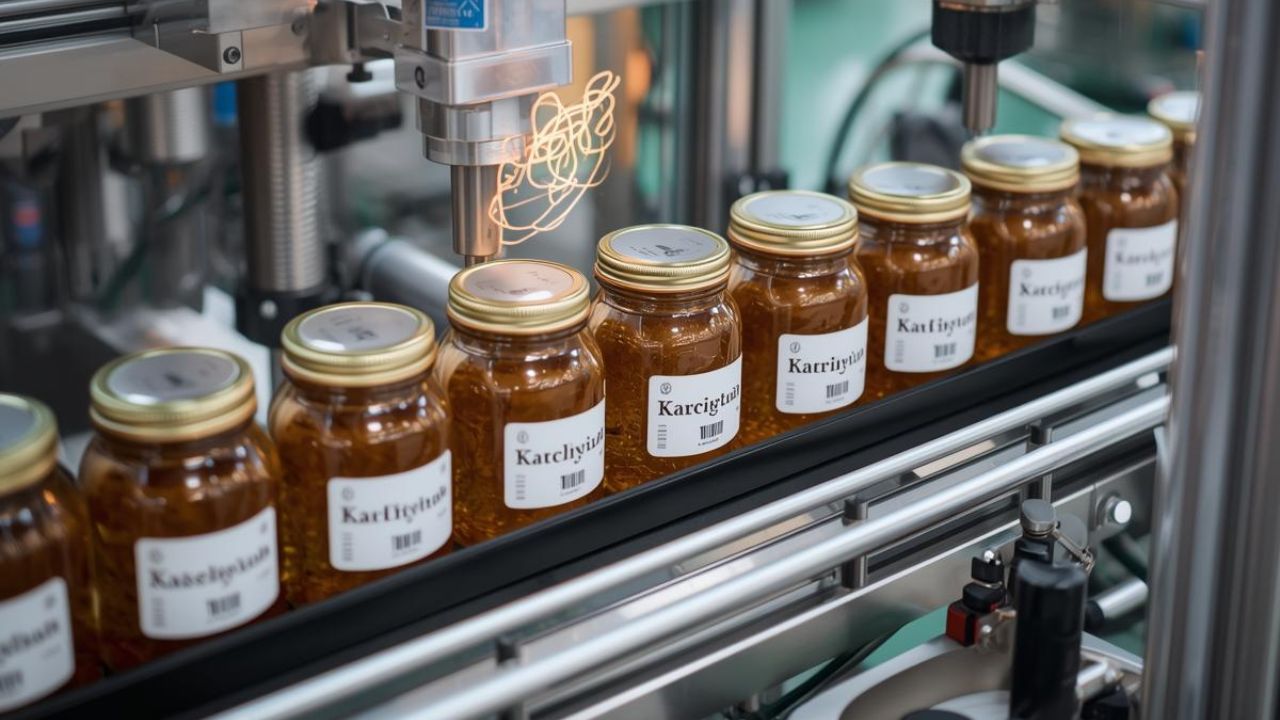
For hot-fill jar applications, product temperature at fill runs 180°F to 203°F (82°C to 95°C). A container at that temperature cannot accept a label. The heat distorts the pressure-sensitive adhesive and prevents proper bond formation. Labeling must happen after the cooling tunnel, this is a non-negotiable placement constraint for any hot-fill operation.
Regulatory requirements also drive placement. The FDA's Principal Display Panel rule requires label application to cover 40% of the total side surface area on round containers. That coverage requirement determines whether you need front-only or wraparound label application, and wraparound systems need the container fully stable, dry, and correctly oriented before the applicator makes contact.
How Do Conveyors, Spacing Screws, and Accumulation Zones Support Stable Label Placement?
A labeler runs at a fixed cycle rate. Everything upstream runs at a variable rate. The conveyor system between them is what keeps those two realities from colliding.
Accumulation tables are the primary buffer. Standard accumulation table disk speeds run 0–8 RPM with a maximum weight capacity of 300 lbs. Undersizing these tables is one of the most common installation mistakes, when the buffer fills, backpressure builds, containers bunch, spacing collapses, and the labeler starts misregistering or jamming.
Conveyor speed variation due to loading, worn bearings, and voltage fluctuations causes label skew. Encoder-based machine synchronization solves this by reading actual conveyor velocity in real time and adjusting label feed speed to match. In one documented integration using Trio Motion Technology's Euro404 motion controller, placement accuracy improved from ±1.0mm to ±0.5mm, and throughput increased by over 25%, not by changing the labeler, but by synchronizing it properly to the conveyor.
When Do You Need Upstream or Downstream Inspection (Barcode, Vision, Tamper Band Verification)?
The labeler is not the last quality gate. It needs both a clean input and a verified output.
Upstream checks catch problems, crooked caps, damaged container necks, surface moisture, before they produce waste. Downstream inspection verifies that the label application worked. Vision inspection systems achieve 99.5%+ accuracy at speeds exceeding 1,000 bottles per minute on high-volume beverage lines. They check label presence, position, barcode readability, and print quality in real time.
In regulated categories, food, pharmaceutical, medical device, downstream barcode-grade verification is not optional. Labeling errors average $10 million per recall incident. A vision system that catches one bad lot pays for itself before the recall paperwork is finished. Build inspection into the line at commissioning, not as a retrofit after the first quality escape.
What Are the Key Challenges When Adding a Labeling Unit to an Existing Line?
Retrofitting a labeler into a running line is harder than building one in from the start. You're fitting new equipment into fixed constraints, existing conveyors, PLCs, electrical drops, and floor space that weren't designed around the labeler. Each constraint is a potential failure point. Know them before installation, not during commissioning.
Why Do Speed Mismatches Create Jams, Skewed Labels, and Downtime (and How Do You Prevent Them)?
A labeler runs at a fixed cycle. The rest of the line doesn't. That gap is where jams and skewed labels originate.
Label speed synchronization must stay within 2% of line speed to prevent jams and skips. Label skew or rotation must remain below 2 degrees. Exceed either tolerance and you get misregistration, wrinkled labels, or products cycling through the reject gate faster than the line can recover.
The mechanical fix is an accumulation conveyor between the filler and the labeler. It acts as a speed buffer, absorbing upstream variation so the labeler sees a consistent, controlled feed rate. Without it, any speed fluctuation upstream translates directly into a label placement error downstream. Size the accumulation zone to your worst-case surge rate, not your average throughput.
What Mechanical Fit Issues Show Up First (Line Height, Footprint, Guarding, Container Handling, Change Parts)?
The first thing you discover on installation day is that nothing quite lines up. Conveyor bed heights vary significantly across equipment generations and manufacturers.
The CVC 300 Wrap Labeler runs at a standard bed height of 36 inches (±2 inches). The Tronics S3S ranges from 33.25 to 39.25 inches. A height mismatch between the labeler infeed and the upstream conveyor means containers tip, drag, or jam at the transition, none of which is visible during the FAT. Resolving it requires shimming, riser plates, or new conveyor sections.
Application roller runout must stay below 0.005 inch TIR. Exceed that, and the roller applies uneven pressure across the label face, causing wrinkling and bubble defects that look like adhesive problems but are actually mechanical ones. Check runout at installation and re-verify it at every major preventive maintenance interval.
What Control and Communication Problems Appear (PLC Signals, Handshakes, Encoder Integration, Safety Circuits)?
The protocol you use must match the speed and determinism your label application process actually requires.
- EtherNet/IP supports cycle times as low as 1ms with CIP Motion and data rates up to 1000 Mbps, the right choice for North American lines running motion-synchronized labeling.
- PROFINET IRT achieves sub-1ms cycle times with jitter under 1µs, the standard for high-speed European lines where synchronized motion is non-negotiable.
- Modbus runs at 10–50ms cycle times, sufficient for status monitoring and fault reporting, not for real-time label triggering at high speeds.
- DeviceNet tops out at 500 kbit/s with a maximum of 64 nodes, appropriate for sensors and actuators at the device level, not high-speed data exchange.
Choose EtherNet/IP or PROFINET for triggering and motion sync. Modbus or DeviceNet works for status monitoring and device-level I/O. Mixing them up is a common retrofit mistake that creates intermittent faults that are difficult to trace.
What Label-Material Issues Cause Failures (Adhesive Set Time, Curl, Static, Liner Breaks, Print Quality)?
When labels wrinkle, miss, or fail to dispense consistently, the instinct is to adjust the machine. Often, the problem is the sensor or the material path.
Sensor selection matters more than most teams realize. At 220 m/min, capacitive sensors maintain 100% detection accuracy within ±0.1mm. Optical sensors drop to 68% at that speed. Ultrasonic sensors fell to 12%. If you're running a high-speed line with optical or ultrasonic label gap sensors, those sensors are the bottleneck, not the applicator. Replace them with capacitive sensors before adjusting anything else.
The label separating plate height directly affects peel consistency. The plate should be positioned 3–5mm above the labeling object. Too high and the label droops before contact. Too low and it drags, causing curl and mis-feeds. This is a field adjustment that takes minutes to set correctly and hours of defects to diagnose if it's wrong.
What Compliance and Traceability Risks Increase During Retrofit (UDI/Lot Coding, Barcode Grade, Recordkeeping)?
Adding a labeler to a regulated line means adding traceability infrastructure at the same time. Retrofits that treat the labeler as a standalone machine and wire up compliance later create systems that produce accurate labels with no verifiable audit trail.
Automated labeling systems with integrated inspection achieve 99.9% labeling accuracy and reduce manual data entry by 40%, both critical for serialization compliance.
PackML (Packaging Machine Language) standardization connects labeler data to MES and enterprise systems. Retrofits that skip PackML create data islands, the labeler runs and logs faults locally, but none of that information flows upstream to production reporting or quality systems. Build compliance architecture into the retrofit scope from the start. It is significantly harder and more expensive to add after the machine is running.
How Do You Match a Labeling Machine to Your Containers, Labels, and Speed Requirements?
Equipment selection fails when teams start with the machine and work backward to the container. The correct sequence is container first, then label type, then speed and accuracy requirements, then features. Make those decisions in order, and the right machine becomes clear.
When Should You Choose Pressure-Sensitive Labeling vs. Sleeve Labeling vs. Print-and-Apply?
Three methods cover the majority of packaging line automation applications. Each fits a specific container and compliance profile.
Choose pressure-sensitive wipe-on if your containers are flat or tapered and line speed is the primary constraint. It's the highest-throughput option and requires matched label and product speeds by design, machine synchronization is built into the application physics.
Choose a shrink sleeve when the container is contoured, requires 360-degree graphics, or needs tamper-evident closures. Pressure-sensitive adhesive cannot conform to complex geometry without flagging or lifting at the edges. Shrink sleeve conforms under heat and locks to the shape, at the cost of a more complex integration involving heat tunnel management and controlled cooling.
Choose print-and-apply when label content changes per unit or per batch, and a fixed pre-printed label cannot satisfy regulatory requirements. It's a compliance and traceability solution, not a speed-first solution.
What Accuracy Specs Should You Care About (Placement Tolerance, Repeatability, Label Gap Sensing)?
Label placement accuracy ranges from ±0.01 inches on high-precision systems like the Weber Alpha HSM to ±1mm on standard production labelers like the Alpha-Pack ALB-515 and Onitex L300. The tighter the spec, the more the system depends on servo-controlled dispensing with live encoder feedback.
For most timing and triggering systems, the working accuracy range is ±1/32 inch (0.8mm) to ±1/16 inch (1.6mm). That's sufficient for standard retail label application. Tighter than that, anti-counterfeit features, tamper-evident overlaps, UDI placement, requires servo dispensing and encoder synchronization as non-negotiable hardware choices.
Specify sensor type and accuracy alongside placement tolerance. They are the same decision. If the sensor cannot reliably detect label gaps at line speed, the dispensing cycle fires at the wrong moment, and placement error accumulates across every container.
What Features Reduce Changeover Pain (Tool-Less Adjustments, Recipe Settings, Quick-Change Parts)?
Changeover time directly reduces available production time. On a multi-SKU line running multiple shifts, a labeler that takes 45 minutes to change over is a scheduled bottleneck.
Modular labeler designs reduce changeover downtime by up to 50% compared to fixed-tooling configurations. Tool-less adjustments, quick-change format parts, and guide systems that index to known positions eliminate measurement and trial runs.
HMI recipe management with electronic line shafting eliminates the recalibration step. When an operator calls up a saved recipe, the system resets all axis positions, speed ratios, and timing parameters automatically. The line can accelerate to full speed after a changeover without a technician walking each station.
If your line runs more than two SKUs, treat changeover time as a hard specification during equipment selection, the same way you treat units per minute or placement accuracy.
What Is the Step-by-Step Process for Integrating a Labeling Machine Into an Existing Line?
Most integration problems are not equipment problems. They're process problems, surveys that missed a constraint, electrical drops that weren't sized correctly, and commissioning that skipped reject verification. A structured four-phase approach catches those gaps before they become downtime. Each phase has a defined output. If you can't produce that output, the phase isn't done.
How Do You Run a Site Survey and Line Audit to Confirm Constraints and Opportunities?
The site survey is not a formality. It's the document that determines whether the equipment you're about to buy will actually fit and function in the space you have.
The pre-integration assessment must cover materials, surface textures, production speeds, available space, and future expansion requirements. Current operational needs alone are not a sufficient scope. A labeler specified only for today's SKU mix becomes a constraint the moment volume grows or a new container format is introduced.
Work through each system in the audit checklist in order: label application mechanism, web tracking and tension, dancer arm positioning, product detection sensors, label gap sensing, registration mark sensing, print legibility, and barcode readability. Each item corresponds to a failure mode. Document everything with dimensions, photos, and existing equipment specs.
How Do You Plan Line Modifications (Conveyor Changes, Infeed/Outfeed, Accumulation, Electrical Drops)?
Line modifications are where integration budgets overrun. The equipment cost is fixed. The civil, electrical, and mechanical work is not, and it expands to fill whatever wasn't planned.
Electrical capacity must be confirmed before the machine ships. Small-to-medium automatic packing lines draw 10–30 kW. Large, high-speed lines can require 50 kW or more. If the existing panel doesn't have capacity, you need a new electrical drop, and that requires lead time that doesn't compress easily.
Compressed air is the other utility that gets underspecified. Blow-on and tamp-blow applicators used on delicate or irregularly shaped products are highly air-volume-sensitive. Size the air supply to peak demand across all actuators running simultaneously, not to the labeler spec sheet in isolation. An undersized air supply causes inconsistent application force, producing the same defects as a mechanical misalignment.
How Do You Validate Performance During Commissioning (FAT/SAT, Test Packs, Reject Verification)?
Factory Acceptance Testing (FAT) happens at the equipment supplier's facility before shipment. Run the labeler at target speed with your actual containers and labels. Measure placement accuracy, cycle rate, reject gate function, and HMI response. Document results against the performance baseline defined in the audit phase.
Site Acceptance Testing (SAT) happens after installation. This is where integration-specific variables appear: conveyor timing, encoder synchronization, PLC handshakes, and safety circuit function. Run test packs through the full line, not just through the labeler in isolation.
When FAT and SAT are executed against defined baselines, integrations show up to a 30% increase in production throughput and a 50% reduction in labeling-related downtime. Specify pre-application rejection if your line runs regulated serialized product, systems like Weiler's Interceptor remove non-conforming labels before application, cutting label waste and eliminating downstream reinspection.
How Do You Train Operators and Lock In Standard Work to Keep Results Consistent?
Standard work and operator training are commissioning deliverables, not post-go-live tasks. Equipment performance degrades when operators don't understand what normal looks like.
HMI interface consolidation with built-in training modules, maintenance reminders, and structured troubleshooting guidance directly improves OEE by reducing unplanned stops from operator error. When an operator knows what a fault code means and what the first response is, the line restarts in minutes instead of an hour.
Lock in standard work before handoff: changeover procedures, cleaning intervals, sensor verification steps, and escalation criteria for faults the operator cannot clear. A labeling machine integration that ends at equipment installation, without trained operators and documented standard work, will underperform its spec within weeks.
Ready to Integrate a Labeling Machine Without the Guesswork?
Labeling machine integration done right tightens line efficiency, eliminates bottlenecks, and builds traceability into every unit from day one. Done wrong, it creates problems that outlast the installation team. The difference is in the process: audit first, plan modifications before equipment ships, validate against defined baselines, and train operators before handoff.
Every line is different. Container geometry, line speed, compliance requirements, and existing control architecture all shape the right solution. At Wolf Packing, we engineer packaging line automation to fit your operation, not a template. If you're planning a labeling integration or evaluating where your current line is losing efficiency, contact us. We'll help you get it right the first time.