Key Takeaways:
- Viking Masek achieves changeovers under 5 minutes using quick-change tooling systems that eliminate manual tool requirements.
- SMED principles convert internal changeover tasks to external preparation, reducing machine downtime by 20% to 40%.
- Digital recipe systems and servo presets cut manual adjustment time by 50% to 70% compared to traditional methods.
- Predictive maintenance with IoT sensors prevents hardware failures that cause quick-change components to stick, jam, or misalign.
- Integrated line synchronization through real-time data exchange reduces total line restart time after format changes.
Changeover time directly impacts production efficiency, equipment utilization, and operational costs. In premade pouch filling operations, changeovers occur multiple times per shift, especially in high-mix environments. A 73% reduction transforms production schedules, increases throughput, and improves overall equipment effectiveness (OEE). This article examines the factors controlling changeover duration and provides actionable methods to achieve measurable reductions.
What does changeover time mean on a premade pouch-filling machine?
Changeover time represents the complete transition period between production runs. It includes all mechanical adjustments, component swaps, calibrations, and test runs required to switch from one product or pouch format to another.
How is changeover time defined from "last good pouch" to "first good pouch"?
Changeover time starts when the last acceptable pouch exits the machine and ends when the first acceptable pouch from the new run meets quality specifications. Viking Masek reports achieving changeover in under 5 minutes on rotary pouch fill and seal machines, establishing a concrete benchmark for rapid format transitions.
How do pouch format, product type, and tooling adjustments contribute to total changeover duration?
Pouch format changes require gripper, magazine, and seal station adjustments. Product type changes demand filler head swaps, nozzle replacements, and dosing recalibrations. Tooling adjustments include replacing forming collars and repositioning guide rails. The cumulative effect determines total downtime. High-mix facilities experience longer changeovers due to more formats and product combinations.
How does changeover performance influence OEE, throughput, and scheduled production time?
A 20-minute changeover executed five times per shift removes 100 minutes from productive operation. This impacts OEE by lowering availability. Faster changeovers increase throughput by maximizing run time and improve schedule adherence by reducing time buffers between production orders.
What factors make premade pouch machine changeovers longer than they should be?
Most changeover delays stem from avoidable mechanical complexity, unclear procedures, and inefficient task sequencing. Manufacturers often accept extended changeovers as unavoidable when they result from correctable design and process issues.
How do manual adjustments and tool-reliant mechanisms slow down changeovers?
Manual adjustments require operators to measure, position, and verify settings using hand tools. Traditional tool-dependent systems are being phased out as quick-change tooling systems become the industry standard. Tool-less mechanisms use spring-loaded pins, cam locks, and quick-release latches that operators activate by hand, eliminating wrenches and screwdrivers entirely.
How do pouch magazine repositioning, gripper width changes, and seal-station adjustments contribute to downtime?
Each adjustment involves loosening fasteners, moving components, measuring positions, testing the function, and making corrections. The pouch magazine must align with different dimensions. Gripper width accommodates varying pouch widths. Seal stations modify jaw pressure, dwell time, and temperature for different materials. The sequential nature of these tasks extends the total changeover time.
How do filler, nozzle, or dosing head revisions add complexity during product changes?
Liquids use piston fillers or pumps. Powders require an auger powder filling machine for consistent dosing. Particulates demand bucket elevators or vibratory feeders. Switching involves disconnecting filler heads, removing nozzles, installing replacement components, and reconnecting supply lines. Dosing head revisions require recalibration of fill weights, flow rates, and valve timing. Cleaning between product types adds additional time, especially with allergen controls.
How do labelers, coders, and inspection devices increase reset time between runs?
Labelers require new label rolls and positioning adjustments. Coders need updated print files and realignment. Inspection devices—checkweighers, metal detectors, vision systems—require new reject thresholds and reference images. Each device operates independently, and their collective reset time compounds the total line changeover duration.
How do machine design and change-part architecture affect changeover time?
Machine design determines changeover speed more than operator skill. Well-designed machines incorporate features that eliminate adjustment steps, reduce component counts, and simplify format transitions.
How do quick-change, tool-less components reduce mechanical adjustment steps?
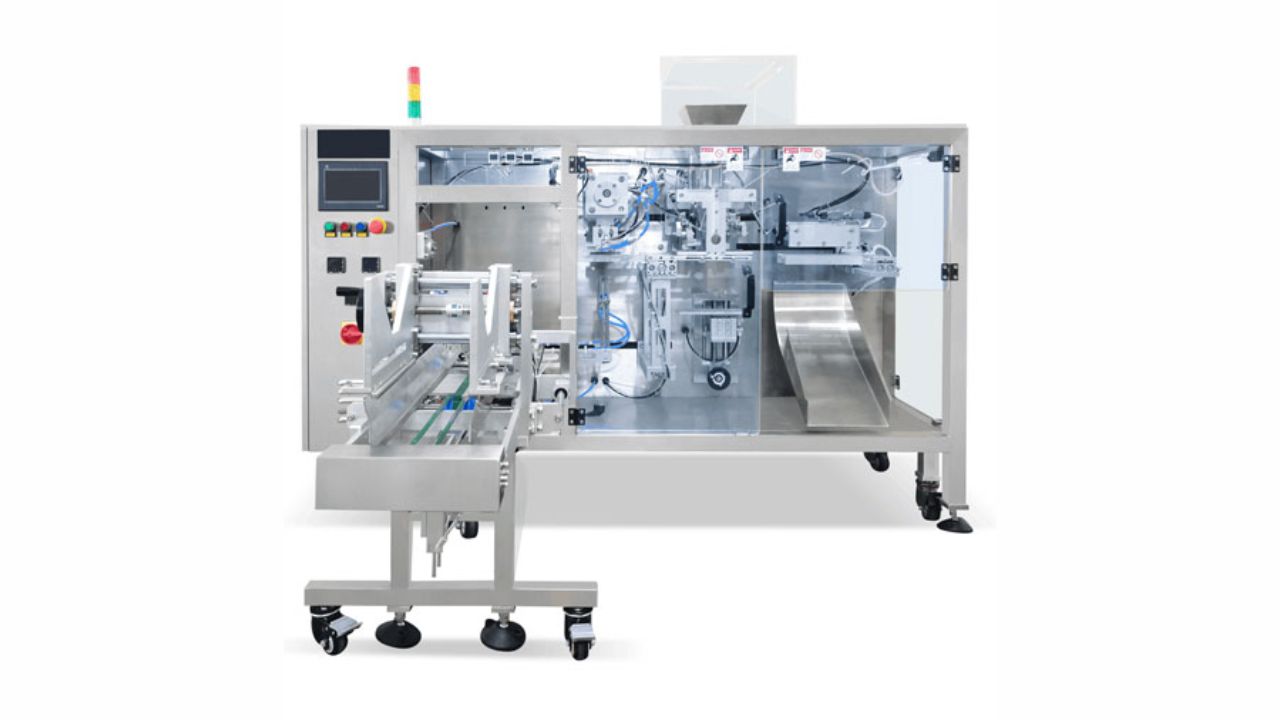
Quick-change tooling systems are becoming the standard in modern premade pouch filling equipment. Spring-loaded pins release with a pull. Cam locks rotate 90 degrees to secure parts. Magnetic couplings engage automatically without threaded fasteners. Each tool-less mechanism removes 30 to 90 seconds from changeover sequences. Across ten adjustment points, this saves 5 to 15 minutes per changeover.
How do modular pouch clamps, grippers, funnels, and spouts shorten conversion time?
Modular change parts are installed as complete assemblies rather than individual components. Pouch clamps slide into guide rails and lock with single-action latches. Grippers mount on quick-change brackets with indexed positions. Funnels and spouts attach via bayonet mounts. Modular design reduces individual adjustments and improves repeatability because each module returns to a known, verified position.
How do preset indicators, guides, and digital scales simplify position verification?
Preset indicators mark correct component positions for each format. Guide rails feature detents that click into indexed positions. Digital scales provide instant feedback on gripper spacing, magazine width, and seal jaw gap. These features eliminate manual measurement with calipers. Verification time drops from several minutes to seconds.
How do product and pouch characteristics influence changeover complexity?
Product properties and pouch configurations determine the scope of required adjustments. Understanding these relationships helps manufacturers anticipate changeover demands and prioritize equipment features addressing their specific product mix.
How do liquids, powders, and particulates each require different fillers and nozzle setups?
Liquids flow through tubes and require piston pumps or gravity-fed systems with smooth-bore nozzles. Powders demand auger fillers with agitation and fluidization jets. Particulates are used bucket conveyors with wide-opening nozzles and impact plates. Switching between product states requires complete filler changeovers, not just nozzle swaps. Each system has unique cleaning, calibration, and verification requirements.
How do flat, stand-up, gusseted, and zipper pouches change the number of required adjustments?
Flat pouches require minimal adjustments. Stand-up pouches need bottom gusset forming stations. Gusseted pouches require side pleat folders. Zipper pouches demand zipper application heads, alignment guides, and compression rollers. Each pouch type introduces specialized change parts. Facilities running multiple pouch styles experience longer changeovers than single-format operations.
How do fitments (spouts, valves, caps) add additional change-part requirements?
Fitments require dedicated applicator heads. Spout applicators orient and press spouts into pre-made openings. Each applicator requires format-specific tooling: mandrels, insertion probes, and alignment fixtures. Adding fitments can double changeover time because the machine runs two simultaneous processes—pouch handling and fitment application—both requiring independent setup.
How does cleaning and sanitation contribute to total changeover time?
Cleaning requirements vary by product type, allergen status, and regulatory environment. Food, beverage, and pharmaceutical manufacturers face strict sanitation protocols, extending the changeover duration.
How do allergen, flavor, and product cross-contamination rules shape cleaning duration?
Allergen changeovers require complete equipment teardown and sanitization. Flavor changes demand thorough cleaning to prevent taste carryover. Each cleaning protocol has defined steps, approved chemicals, and verification methods. Allergen-related cleaning can add 30 to 120 minutes to changeover time, exceeding mechanical changeover duration in many facilities.
How do wash-down vs. dry-cleaning methods impact equipment readiness?
Wash-down cleaning uses water, detergents, and sanitizers, but requires drying time before the next product runs. This adds 15 to 45 minutes. Dry cleaning uses brushes, vacuums, and compressed air without introducing moisture. Dry methods eliminate drying time but are less effective for sticky or liquid products.
How does hygienic machine design minimize cleaning-related downtime?
Hygienic design eliminates residue traps. Sloped surfaces prevent product accumulation. Rounded corners eliminate crevices. Tool-less disassembly allows quick access to product zones. Removable parts can be cleaned offline. Quick-disconnect fittings enable rapid removal. Machines built to 3-A or EHEDG standards reduce cleaning time by 30% to 50%.
How should you analyze your existing changeover process before targeting a 73% reduction?
Baseline measurement establishes current performance and identifies improvement opportunities. Without accurate data, improvement efforts lack focus. A structured analysis reveals which tasks consume the most time.
How do you map the current changeover steps using a last-good-to-first-good framework?
Start timing when the last acceptable pouch exits. Record each task: stopping the machine, removing old change parts, installing new components, adjusting settings, running test pouches, and achieving the first good pouch. Document who performs each task, the duration, and the required tools. Video recording provides objective evidence. Most facilities discover that 40% to 60% of changeover time involves waiting, searching for tools, or correcting errors.
How do you identify internal vs. external tasks using SMED mapping?
Single-Minute Exchange of Die (SMED) principles distinguish internal tasks—performed while the machine is stopped—from external tasks—performed while the machine runs. Mapping reveals opportunities to convert internal tasks to external ones. Pre-staging change parts, preparing tools, and loading product before shutdown are external activities. The goal is to minimize internal tasks.
How do you quantify task duration, variability, and root causes of delay?
Measure each task multiple times across different operators and shifts. Calculate average, minimum, and maximum duration. High variability indicates a lack of standardization. Identify root causes: missing tools, unclear instructions, difficult adjustments, or equipment malfunctions. Quantified data directs improvement efforts toward high-impact areas.
What are the main steps to reduce premade pouch changeover time by 73%?
Achieving a 73% reduction requires systematic application of proven methodologies. The following five steps provide a structured approach delivering measurable results.
Step 1 — How do you convert internal tasks into external tasks using SMED principles?
Review the baseline task map and identify activities that can be performed while the machine runs. Prepare change parts at a staging area during production. Pre-measure adjustable components. Load the new product before shutdown. Create a pre-changeover checklist that operators complete during the final 15 minutes of each run. This eliminates search time and reduces internal tasks by 20% to 40%.
Step 2 — How do you standardize tools, components, and task sequences?
Use the same tools for all adjustments. Store tools in shadow boards at each machine. Create standard work instructions with photos. Number change parts and mark installation locations. Establish a fixed task sequence. Standardization reduces training time and eliminates errors. Facilities with standardized procedures achieve 15% to 25% time reductions through consistency alone.
Step 3 — How do you implement quick-release mechanisms and modular change parts?
Replace threaded fasteners with quick-release alternatives. Install cam locks, spring pins, and magnetic couplings. Design change parts as complete assemblies. Use keyed connections that only fit in correct orientations. Each mechanical simplification saves 30 to 90 seconds. Across 15 adjustment points, quick-release mechanisms eliminate 7 to 22 minutes per changeover.
Step 4 — How do digital recipes and servo presets minimize manual adjustments?
Digital systems store machine configurations for each product and format combination. Recipe-based settings allow operators to recall pre-configured parameters for grippers, seal stations, and filling equipment with a single button press. Digital calibration presets enable faster transitions by eliminating manual calculations. Servo-driven modules automatically position components. Recipe systems cut adjustment time by 50% to 70%.
Step 5 — How do you lock in improvements through operator training and timed trials?
Train operators on new procedures, tools, and digital systems. Conduct timed changeover trials. Set progressive time targets: first 30% reduction, then 50%, then 73%. Recognize operators who meet targets. Continuous practice builds muscle memory. Document best practices and update standard work instructions. Sustained performance requires ongoing training, measurement, and management attention.
How do digital controls and automated presets shorten pouch changeovers?
Digital systems eliminate manual adjustments, reduce errors, and accelerate format transitions. They represent the most significant technological advancement in changeover reduction.
How do saved pouch "recipes" automatically adjust grippers, stations, and filler settings?
Recipe systems store every machine parameter for each product and pouch format. Parameters include gripper width, seal jaw gap, filler nozzle height, conveyor speed, and inspection thresholds. Operators select the appropriate recipe from a touchscreen menu. The machine's control system sends commands to servo motors and actuators. Components move to stored positions automatically in 30 to 90 seconds compared to 10 to 20 minutes for manual adjustment.
How do smart sensors, position memory, and servo-driven modules reduce variability?
Smart sensors verify components reach target positions. Position memory stores verified coordinates and reproduces them exactly during each changeover. Servo-driven modules move to stored positions with micrometer precision. This eliminates measurement errors and trial-and-error adjustments. First-run yield increases because settings are correct from the start.
How do barcode, RFID, or job-ID systems prevent setup errors and downtime?
Barcode and RFID systems link physical change parts to digital recipes. Operators scan a barcode on the new change part set, and the control system loads the corresponding recipe automatically. This prevents operators from selecting the wrong recipe or entering incorrect parameters. Error-proofing reduces rejected pouches during startup and prevents product waste.
How do inspection, coding, and downstream equipment affect total line changeover time?
Premade pouch fillers operate as part of integrated packaging lines. Downstream equipment must be reconfigured simultaneously with the filler. Coordinating these changeovers determines total line downtime.
How do checkweighers, metal detectors, and vision systems need to be realigned for new SKUs?
Checkweighers require new target weights and reject thresholds. Metal detectors need sensitivity adjustments based on product density. Vision systems require new reference images. Each device must be calibrated and verified with test samples. Combined setup time for inspection equipment can equal or exceed filler changeover duration. Real-time data synchronization is critical for coordinating multiple pieces of equipment during line restarts after changeovers.
How do labelers, coders, and printers add to overall format-change duration?
Labelers require new label rolls and position adjustments. Thermal transfer printers need updated print files and ribbon replacement. Inkjet coders require new message content and calibration. Each device operates independently unless integrated through a central control system. Multi-robot coordination platforms are emerging as solutions for managing complex packaging line synchronization.
How do conveyors, packers, and line synchronization influence restart performance?
Conveyor guides must be adjusted to match the new pouch dimensions. Case packers require pattern changes and carton size adjustments. Robotic palletizers need updated stack patterns. Line synchronization ensures all equipment restarts simultaneously without collisions. Integrated control systems synchronize line speed, product spacing, and device timing for smooth restarts.
How does preventive maintenance enable consistently fast changeovers?
Preventive maintenance keeps quick-change hardware functioning properly. Worn components stick, jam, or misalign, adding time to every changeover. Regular maintenance prevents these problems.
How does maintaining quick-change hardware prevent sticking, jamming, or misalignment?
Quick-change mechanisms rely on precision components that wear over time. Vibration sensors are crucial for identifying mechanical problems in rotating equipment. These sensors detect changes in vibration patterns indicating imbalances, misalignments, or bearing wear—all of which can cause quick-change components to stick or jam. Temperature sensors monitor machinery and motors. Abnormal temperature variations signal overheating, lubrication problems, or electrical faults that could compromise changeover hardware performance.
How do pre-changeover inspections reduce surprises and troubleshooting delays?
Operators should inspect quick-change hardware during scheduled changeovers. Check for worn pins, damaged alignment features, and missing fasteners. Predictive maintenance minimizes unplanned downtime by identifying potential issues before they escalate into major failures. This allows manufacturers to schedule maintenance during planned downtime, eliminating surprises during changeover operations.
How do documented PM routines lower both mechanical and cleaning-based downtime?
Documented preventive maintenance schedules specify lubrication points, cleaning intervals, and replacement frequencies. Regular monitoring and timely maintenance interventions extend equipment lifespan by addressing issues at an early stage. Documented preventive maintenance ensures equipment operates at optimal performance levels, leading to higher productivity and improved product quality during and after changeovers.
How does Wolf-Packing Machine Company help reduce premade pouch changeover time?
Wolf-Packing Machine Company designs equipment and services specifically focused on changeover efficiency. Their engineering approach prioritizes tool-less design, automation integration, and operator-friendly features.
How do Wolf-Packing's tool-less, modular change parts eliminate unnecessary mechanical steps?
Wolf-Packing machines incorporate quick-release mechanisms throughout the machine platform. Pouch grippers, forming collars, and filler nozzles install without tools. Change parts use keyed connections and indexed positions for repeatable setup. Modular assemblies replace multi-component adjustments with single-motion installations. The engineering philosophy emphasizes operator efficiency, resulting in machines that perform better in high-mix production environments.
How do WPMC automation features, servo presets, and digital recipes accelerate format transitions?
Wolf-Packing control systems include recipe management as a standard feature. Operators store unlimited format configurations and recall them instantly. Servo-driven positioning systems move grippers, magazine guides, and seal stations automatically. The touchscreen interface provides visual confirmation of proper setup. Automation eliminates manual measurement and reduces human error.
How do Wolf-Packing integration services align fillers, coders, conveyors, and inspection systems for fast restarts?
Wolf-Packing provides system integration services to ensure every component operates in flawless unison, enhancing efficiency and productivity while minimizing downtime and costs. Integration specialists synchronize control systems across multiple equipment brands. They configure real-time data exchange between devices, minimizing delays and reducing errors. Software solutions are user-friendly and customizable to meet specific business needs.
How do onsite training, optimization audits, and support services achieve measurable downtime reduction?
Wolf-Packing offers onsite operator training focused on efficient changeover execution. Training includes hands-on practice, timed trials, and best-practice documentation. Optimization audits identify remaining improvement opportunities. Support services provide ongoing guidance as production requirements evolve. This combination of equipment, integration, and support delivers measurable results.
What KPIs verify a 73% reduction in premade pouch changeover time?
Measurement validates improvement initiatives and sustains long-term performance. Key performance indicators provide objective evidence of progress.
How should you measure average, best, and worst-case changeover durations?
Track every changeover with start and stop times. Calculate average changeover time by summing all durations and dividing by the number of events. Identify the best-case time to establish the achievable target. Record the worst-case time to reveal persistent problems. Plot these metrics weekly to visualize trends. A 73% reduction means a 20-minute baseline changeover decreases to 5.4 minutes.
How do OEE, availability, and uptime metrics validate improvements?
OEE combines availability, performance, and quality into a single metric. Changeover time directly impacts availability. Reducing changeovers from 20 minutes to 5.4 minutes increases daily production time. Calculate availability as (operating time ÷ scheduled time) × 100. A successful initiative increases OEE by 5 to 15 percentage points.
How do you ensure improvements persist across shifts, operators, and formats?
Sustainability requires ongoing measurement and management attention. Audit changeover performance monthly. Compare results across shifts to identify training gaps. Track performance by format. Conduct refresher training when performance drifts. Public dashboards displaying changeover metrics create accountability.
What questions do manufacturers commonly ask about premade pouch changeovers?
Manufacturers considering changeover improvement initiatives often have concerns about feasibility, cost, and implementation complexity.
Can older machines be retrofitted to achieve faster, tool-less changeovers?
Retrofit feasibility depends on machine design. Simple retrofits include replacing fasteners with quick-release alternatives and adding preset indicators. More complex retrofits involve installing servo positioning systems and upgrading control systems. Most machines can achieve 30% to 50% time reductions through mechanical retrofits. Achieving 70%+ reductions usually requires both mechanical and automation upgrades.
Can a high-mix, multi-SKU operation realistically hit a 73% time reduction?
High-mix operations benefit most from changeover improvements because they perform more frequent format changes. Achieving 73% reductions requires the systematic application of all five improvement steps plus digital recipe systems. The key is standardizing change parts across product families. High-mix facilities that implement comprehensive changeover programs consistently achieve 65% to 75% reductions.
Can aggressive changeover targets be met without compromising food safety?
Food safety and changeover speed are compatible goals. Predictive maintenance identifies potential hazards before they result in accidents or injuries. Humidity and moisture sensors monitor levels that can impact equipment performance. Excessive humidity can lead to corrosion and electrical short circuits—critical concerns in food-grade environments where sanitation and safety cannot be compromised. Recipe systems include cleaning validation steps and allergen lockout features.
Can improvements scale across multiple pouch fillers and packaging lines?
Standardization enables scalability. Design change parts and procedures that work across multiple machines. Implement identical digital systems on all fillers. Train operators using the same standard work instructions. Improvements replicate faster when systems are standardized. Facilities with five or ten machines achieve faster overall improvement because operators gain more practice.
What should teams remember when targeting major reductions in changeover time?
Successful changeover improvement requires commitment from operations, maintenance, and engineering. Each function contributes specific knowledge and resources. Coordinated efforts deliver better results than isolated initiatives.
What should operations, maintenance, and engineering each prioritize for sustained performance?
Operations teams must enforce standardized procedures, conduct regular audits, and provide operator training. Maintenance teams should implement predictive maintenance programs. Deploy IoT sensors on selected equipment to collect real-time data. Ensure sensors are strategically placed to capture relevant parameters such as temperature, vibration, humidity, and pressure. Engineering teams must specify quick-change features on new equipment and design modular change parts. Define the objectives of the predictive maintenance program and determine which equipment will be monitored. All three functions must collaborate on root cause analysis when performance degrades.
What next steps to help teams begin reducing premade pouch changeover time immediately?
Start with a baseline measurement. Time all changeovers for two weeks and calculate the average duration. Create a task-level breakdown identifying internal and external activities. Select one high-frequency changeover for pilot improvement. Apply SMED principles to convert internal tasks to external preparation. Standardize tools and create a pre-changeover checklist. Conduct timed trials and track progress weekly. Immediate action creates momentum.
Ready to Cut Your Changeover Time and Boost Production?
Wolf-Packing Machine Company delivers proven solutions for manufacturers serious about eliminating changeover downtime. Our tool-less designs, integrated automation systems, and expert support services help facilities achieve 60% to 75% changeover time reductions. Contact Wolf-Packing today to schedule an optimization audit and discover how our engineering expertise—from multi head weighing machine calibration to complete line integration—can transform your packaging line performance. Start reducing downtime tomorrow.