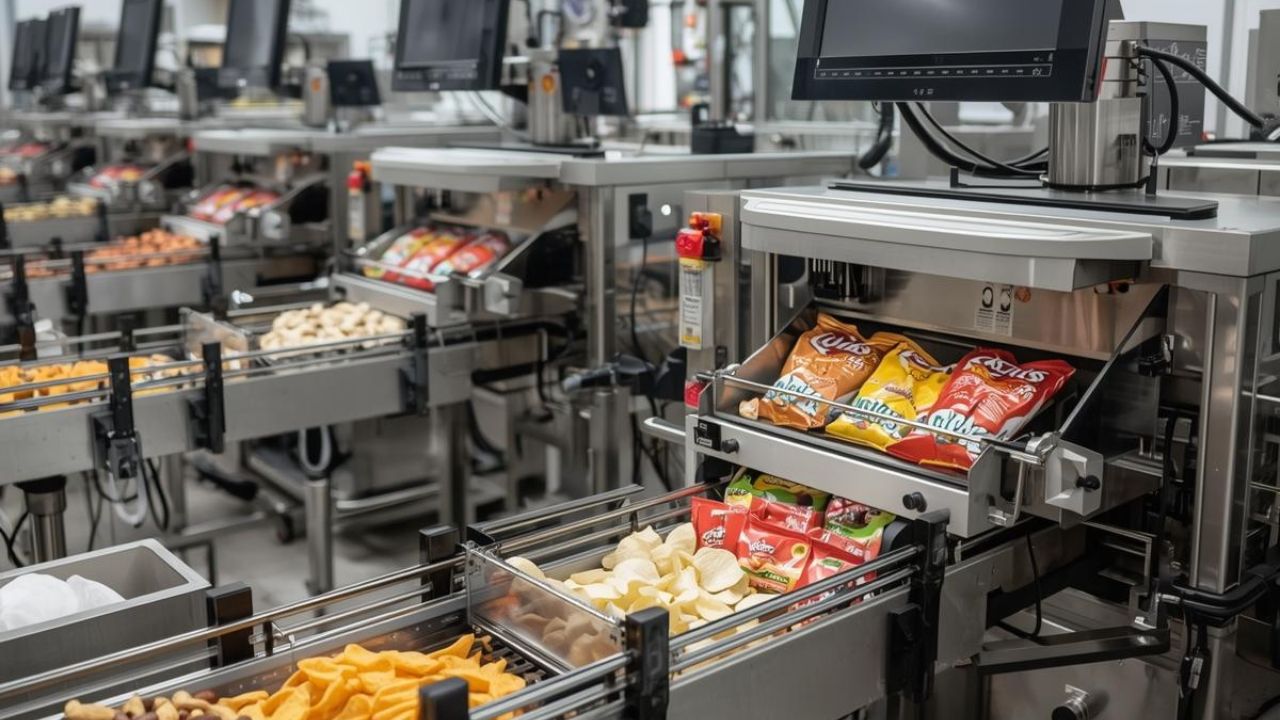
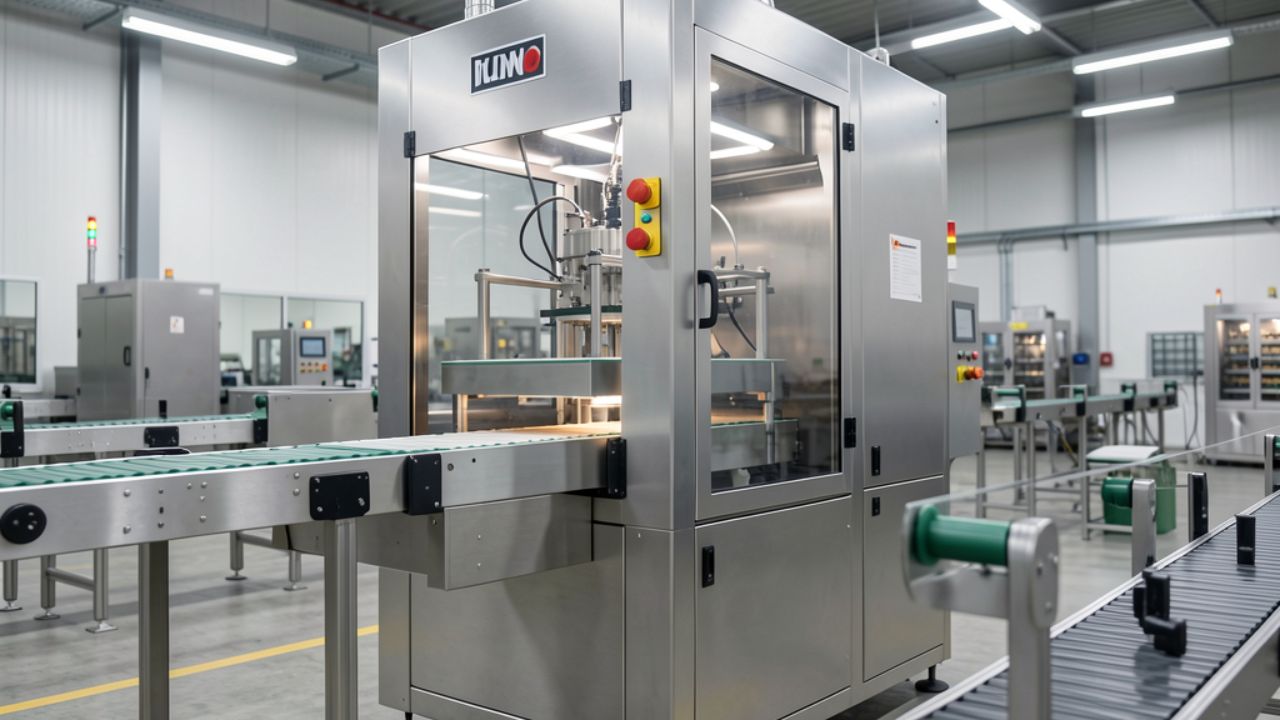
Linear weighers deliver cost-effective automation for free-flowing products at speeds up to 65 bags per minute. Multihead weighers use combinatorial logic to achieve 200+ weighings per minute with exceptional accuracy on fragile, irregular, or mixed products. Combination systems integrate volumetric and gravimetric technologies to meet pharmaceutical-grade precision requirements.
This guide compares mechanical design, performance specifications, and application fit across all three weighing machines types.
Key Takeaways
Linear weighers deliver 20-65 bags per minute at ±0.5g to ±1.0g accuracy with minimal maintenance requirements and capital investment under $60,000.
Multihead weighers achieve 80-200+ weighings per minute at ±0.10g to ±0.30g accuracy, reducing giveaway from 3-5% to under 0.5% with ROI in 12-24 months.
Combination systems provide ±0.2g to ±0.3g pharmaceutical-grade accuracy with OIML R 51 compliance for regulated applications.
Select linear weighers for uniform products under 60 units per minute, multihead for irregular products at 60-200+ units per minute, and combination systems for variable-density products requiring regulatory compliance.
Total cost of ownership (equipment, giveaway, maintenance, labor) often shows multihead systems deliver faster payback than linear systems despite higher capital cost.
What Is A Weighing And Filling Machine In Automated Packaging?
A weighing and filling machine measures product by weight and dispenses precise portions into containers, bags, or pouches. These systems replace manual scooping and eliminate the labor, inconsistency, and giveaway waste inherent in volume-based filling.
How Do Weighing and Filling Machines Measure and Dispense Products?
Linear filling systems feed product via vibratory pans into independent weigh buckets equipped with load cells. Each system uses a two-stage fill process: bulk feed delivers product rapidly, then dribble feed adds small increments until the target weight is reached. Product enters through incline conveyors or bucket elevators.
Multihead filling machines distribute product from a central infeed funnel across 8 to 32 radial weigh hoppers. Each hopper has its own load cell. A microprocessor evaluates all possible weight combinations in real time and selects the group of hoppers whose total weight matches the target most closely. This combinatorial approach delivers both speed and accuracy that linear systems cannot match.
Why Are Automated Weighing Systems Important For Packaging Accuracy And Efficiency?
Automated weighing eliminates manual portioning errors and accelerates production while reducing labor dependency.
Key benefits of automated weighing systems:
Improved filling accuracy and portion control: Pharmaceutical applications achieve ±0.1g to ±0.5g accuracy. Food processing maintains ±0.5g to ±2g tolerances. Industrial products allow ±2g to ±5g variance.
Reduced product waste and giveaway: Multihead weighers cut giveaway from 3-5% down to under 0.5%, translating to significant savings on high-value products.
Higher packaging speed and production efficiency: Linear weighers handle 20-65 bags per minute. Multihead systems reach 200+ weighings per minute.
Lower labor requirements in packaging lines: Manual operations produce roughly 8 bags per minute. Automated systems deliver 28+ bags per minute with a single operator.
Consistent product weight for compliance and quality control: Systems meet OIML R 51 and NIST Handbook 44 net weight standards required for regulatory approval.
What Are The Main Types Of Weighing And Filling Machines?
Three weighing technologies dominate industrial packaging: linear weighers for free-flowing products, multihead weighers for speed and accuracy, and combination systems for pharmaceutical-grade precision. Understanding the mechanical differences helps manufacturers match weighing and filling equipment to specific production requirements.
What Is A Linear Weighing And Filling Machine?
A linear weigher uses 1 to 10 independent weighing heads arranged in a straight-line configuration. Product travels via vibratory feeders into individual weigh buckets. Each bucket discharges when its load cell confirms the target weight. These machines are constructed from food-grade 304 or 316 stainless steel with IP65 or IP68 washdown ratings. The simple mechanical design features fewer moving parts and no radial distribution system, making cleaning and maintenance straightforward.
What Is A Multihead Weighing And Filling Machine?
A multihead weigher distributes product radially to 10, 14, 16, 20, 24, or 32 independent weigh hoppers arranged in a circle. A central computer continuously reads all load cell values and calculates every possible combination of hoppers. The system selects the combination whose sum is closest to the target weight, then triggers those specific hoppers to discharge simultaneously.
Advanced configurations handle up to 8 different product components at once for mixed applications like trail mix or ready meals. Ishida of Japan invented combination weigher technology and remains the global benchmark.
What Is A Combination Weighing And Filling Machine?
Combination weighing filling systems integrate multiple technologies to achieve performance beyond what either system delivers alone. The most common configuration pairs a volumetric filler (auger or cup) for bulk fill with a gravimetric top-off station that adds or removes small amounts to reach precise target weight.
An alternative approach integrates an inline checkweigher with a multi-lane filling line, providing real-time feedback that adjusts fill volumes to compensate for product density variations. These hybrid systems are standard in pharmaceutical packaging where net weight compliance with OIML R 51 is mandatory.
How Does A Linear Weighing And Filling Machine Work?
Linear weighers feed product through vibratory pans into individual weigh buckets. Load cells monitor weight continuously. When the target weight is reached, the bucket gate opens and discharges product into the downstream packaging machine.
What Components Are Used In Linear Weighing Machines?
Core components of a linear weighing system:
Product feed hopper: Stores bulk product and maintains consistent flow
Vibratory feeder or channel feeder: Delivers product at controlled rates
Load cells for weight measurement: Precision sensors that convert weight into electrical signals
Weighing buckets or hoppers: Chambers that accumulate product during fill cycle
Discharge gates: Pneumatic or mechanical gates that release weighed product
Control system or PLC interface: Microprocessor that monitors load cells and controls feed rates
What Types Of Products Are Best Suited For Linear Weighers?
Common product categories:
Granular food products: Rice, beans, sugar, coffee beans, pasta
Powdered ingredients: Flour, spices, protein powder, baking mixes
Small hardware items: Screws, bolts, fasteners, washers
Seeds and grains: Agricultural seeds, quinoa, oats, wheat
Dry pet food: Kibble, treats, dry food pellets
What Are The Advantages And Limitations Of Linear Weighing Machines?
Simple design, easy cleaning, 15-30 min changeovers
Manual intervention for complex changes
Best product types
Free-flowing, uniform products
Not suitable for fragile or mixed products
How Does A Multihead Weighing And Filling Machine Work?
Multihead weighers disperse product radially from a central infeed to independent weigh hoppers. A microprocessor evaluates every possible combination of hopper weights and selects the group closest to target. This combinatorial approach delivers both speed and accuracy.
What Is The Combination Weighing Principle Used In Multihead Systems?
Product flows from a central infeed funnel across radial vibratory feeders into pool hoppers, which fill individual weigh hoppers arranged in a circle. Each weigh hopper has its own load cell transmitting weight data to the central computer. The system calculates all possible hopper combinations in milliseconds and identifies the combination whose total weight best matches the target.
Those specific hoppers open simultaneously, and the product falls through a timing gate into the packaging machine below. Specialized configurations address challenging products: fragile items use shallow-angle dispersion cones and cushioned inserts that reduce breakage by 60%+, while sticky products run on dimpled stainless steel surfaces with screw feeders that prevent buildup.
What Types Of Products Are Commonly Packaged With Multihead Weighers?
Typical product applications:
Potato chips and snack foods
Candy and confectionery
Frozen vegetables and frozen foods
Nuts and dried fruit
Salad mixes and fresh produce
What Are The Advantages And Limitations Of Multihead Weighing Machines?
How Does A Combination Weighing And Filling Machine Work?
Combination systems integrate volumetric and gravimetric technologies for pharmaceutical-grade accuracy at production speeds. Closed-loop feedback compensates for product density variations in real time.
How Do Combination Weighers Integrate Multiple Weighing Mechanisms?
Combination weighers pair different weighing technologies in hybrid configurations. The most common approach combines a volumetric filler for rapid bulk delivery with a gravimetric top-off station that adds or removes small amounts to reach precise target weight. An alternative configuration integrates an inline checkweigher with multi-lane filling, creating closed-loop feedback that dynamically adjusts fill volumes to compensate for bulk density variations.
Volumetric plus gravimetric top-off systems run at 40-100 containers per minute with ±0.2g accuracy. Multi-lane systems with checkweigher feedback achieve 60-120 containers per minute at ±0.3g accuracy. Hybrid linear-multihead configurations reach 80-100 bags per minute at ±0.2g precision.
What Applications Benefit Most From Combination Weighing Systems?
Typical industries and product types:
Snack and packaged food manufacturing
Frozen food processing
Confectionery packaging
Nutraceutical and supplement packaging (infant formula, protein powder requiring ±0.1g to ±0.5g accuracy)
Industrial components requiring high accuracy
What Are The Advantages And Limitations Of Combination Weighing Machines?
Category
Advantages
Limitations
Accuracy
±0.2g to ±0.3g; regulatory compliance (OIML R 51)
Requires skilled calibration
Speed
40-120 CPM depending on configuration
Complex synchronization
Cost
Minimizes giveaway; regulatory compliance ROI
Higher cost: $75,000-$200,000+
Integration
Real-time data logging, quality control
Complex integration requirements
Flexibility
Handles variable-density products
Specialized operator training
What Are The Key Differences Between Linear, Multihead, And Combination Weighing Machines?
Linear weighers deliver cost-effective automation for uniform products. Multihead weighers use combinatorial logic for speed and accuracy on challenging products. Combination systems integrate technologies for pharmaceutical-grade precision. The comparison below shows performance specifications, cost ranges, and application fit.
Which Industries Use Linear, Multihead, And Combination Weighing Machines?
Weighing machines servefood processing, pharmaceutical manufacturing, and industrial packaging operations. Machine selection depends on product characteristics, regulatory requirements, and production volume targets within each sector.
How Are These Machines Used In Food And Snack Packaging?
Typical applications:
Chips and snack foods: Multihead weighers are the industry standard. A 14-head system achieves 100-120 bags per minute while minimizing chip breakage.
Nuts and dried fruits: Linear weighers handle uniform single products. Multihead systems create mixed trail mixes combining multiple ingredients.
Frozen vegetables: Multihead weighers withstand temperature extremes in cold environments. A 16-head configuration delivers 140-160 weighings per minute.
Candy and confectionery: Multihead systems create mixed assortments, combining up to 8 different candy types in precise ratios per package.
How Are They Used In Pharmaceutical And Nutraceutical Packaging?
Pharmaceutical applications demand precision weighing with documented compliance. Linear weighers handle capsule and tablet portioning with ±0.1g to ±0.5g accuracy for consistent dosing. Combination systems address powder supplements with variable bulk density, using volumetric bulk fill plus gravimetric top-off for precision. Nutritional products requiring exact dosing, such as infant formula, use combination systems that meet OIML R 51 net weight compliance standards.
How Are They Used In Hardware And Industrial Product Packaging?
Linear weighers dominate hardware packaging for uniform fasteners and components. These applications tolerate ±2g to ±5g accuracy, making linear systems cost-effective. A 4-head linear weigher produces 30-35 bags per minute for screws, bolts, and washers. Multihead systems create mixed hardware kits containing multiple component types in precise counts per package.
What Should You Consider Before Investing In A Weighing And Filling Machine?
Equipment evaluation starts with performance specifications matched to production requirements. Integration capabilities and scalability determine long-term operational value beyond initial capital cost.
What Performance And Accuracy Specifications Should You Evaluate?
Key performance metrics:
Weighing accuracy tolerance: High-value products justify ±0.1g to ±0.2g precision. Commodity products accept ±1g to ±2g variance.
Maximum packaging speed: Match equipment speed to production targets with 20-30% buffer capacity. Linear systems handle below 60 units per minute. Multihead systems deliver 60-200+ weighings per minute.
Product weight range: Verify the machine handles your target weight range without requiring different head configurations.
Machine footprint and installation space: Linear weighers fit compact spaces. Multihead systems require larger floor space and greater ceiling height for the radial distribution cone.
Integration with upstream and downstream equipment: Verify discharge timing compatibility with VFFS bagmakers, tray sealers, or conveyor systems.
How Important Are Automation, Integration, and Future Scalability?
Equipment integration with packaging lines requires synchronized timing between the weigher discharge and the downstream machine infeed. Container and jar packaging systems depend on precise timing to prevent jamming or spillage. Compatibility with Industry 4.0 monitoring systems enables real-time data logging, remote diagnostics, and predictive maintenance that reduces unexpected downtime.
Scalability matters for growing operations: a 14-head multihead weigher can upgrade to 16 or 20 heads by adding head assemblies, and modular designs support future capacity expansion without replacing the entire system.
How Do Manufacturers Choose The Right Weighing And Filling Machine?
Equipment selection starts with product characteristics, then factors in throughput requirements and operational constraints. The decision framework below evaluates product behavior, production speed, and total cost of ownership.
How Do Product Characteristics Influence Machine Selection?
Product-related factors to evaluate:
Product size and shape: Uniform particles suit linear weighers. Irregular shapes require multihead systems that accommodate variation.
Flowability of the product: Free-flowing materials excel with linear vibratory feeders. Sticky products need specialized multihead configurations with dimpled surfaces.
Fragility or breakage risk: Delicate items need shallow-angle dispersion cones and cushioned inserts that reduce breakage by 60% or more.
Moisture or stickiness: High-moisture or tacky products require dimpled stainless steel contact surfaces that prevent buildup.
Weight range per package: Linear weighers handle consistent target weights efficiently. Multihead systems accommodate wider weight ranges without reconfiguration.
How Do Production Speed And Packaging Line Integration Affect The Choice?
Operational considerations:
Required packaging speed (units per minute): Below 60 units per minute, linear systems provide sufficient speed. 60-150 units per minute requires multihead weighers. Above 150 units per minute demands high-speed multihead configurations.
Integration with existing packaging machines: Linear weighers integrate easily with most VFFS bagmakers and conveyors. Multihead systems require timing synchronization with downstream equipment.
Level of automation in the production line: Manual operations produce roughly 8 bags per minute. Automated systems deliver 28+ bags per minute with reduced labor.
Changeover frequency for different products: Frequent product changes favor linear weighers with 15-30 minute changeovers. Recipe-driven HMI systems on multihead weighers reduce changeover complexity.
How Do Budget, Maintenance, And Operational Requirements Impact The Decision?
Financial and operational factors:
Equipment purchase cost: Linear weighers range from $10,000 to $60,000. Multihead systems cost $50,000 to $250,000 or more. Combination weighers run $75,000 to $200,000 or more.
Maintenance and spare part requirements: Linear systems need minimal maintenance with straightforward cleaning. Multihead weighers require specialized maintenance. Combination systems coordinate multiple technologies.
Operator training needs: Linear weigher operators train in days to weeks. Multihead systems require weeks of training. Combination systems demand specialized technical training.
Long-term operational efficiency: Multihead weighers that reduce giveaway from 3% to 0.5% typically pay for themselves within 12-24 months on high-value products. Small business operations with 10-50 employees see particularly strong ROI from automated weighing systems.
Which Weighing And Filling Machine Type Is Best For Your Packaging Operation?
Choose linear weighers when:
Speed requirements below 60 bags per minute
Free-flowing, uniform, granular products
Budget under $60,000
±0.5g to ±1.0g accuracy acceptable
Simple maintenance and fast changeovers are priorities
Choose multihead weighers when:
Speed requirements 60-200+ weighings per minute
Irregular, fragile, mixed, or sticky products
$50,000-$250,000+ budget justified by reduced giveaway
±0.10g to ±0.3g accuracy required
Minimizing giveaway and maximizing throughput are priorities
Choose combination systems when:
Speed requirements 40-120 containers per minute
Variable-density products or pharmaceutical-grade precision needed
ROI justified through regulatory compliance
±0.2g to ±0.3g accuracy, with net weight compliance mandatory
Regulatory standards (OIML R 51, 21 CFR Part 11) required
Key performance differentiators:
Metric
Linear
Multihead
Combination
Max Speed
20-65 weighings/min
80-200+ weighings/min
40-120 CPM
Best Accuracy
±0.5g to ±1.0g
±0.10g to ±0.30g
±0.2g to ±0.3g
Giveaway
2-3% typical
<0.5% achievable
<1% with feedback
ROI Timeline
8-12 months
12-24 months
12-18 months
Match machine type to your packaging workflow and production goals. Evaluate the total cost of ownership (equipment, giveaway, maintenance, labor) rather than the capital cost alone. Multihead weighers often pay for themselves within 18 months through giveaway reduction on high-value products.
Why Wolf Packing Machine Company For Your Weighing And Filling Automation
Wolf Packing delivers American-made, veteran-engineered packaging solutions built for reliability. Our systems reduce labor dependency while improving accuracy and throughput. We back every installation with lifetime technical support from the engineers who designed your equipment, comprehensive operator training, flexible financing, and a trade-in program that makes automation accessible. You're not buying equipment—you're gaining a partner committed to your production success.
Ready to automate your packaging line with the right weighing technology? Contact Wolf Packing to discuss your production requirements and get expert recommendations.
At Wolf-Packing Machine Company, we believe that the key to success is a commitment to excellence in everything we do. That’s why we use only the highest quality materials and the most advanced technology to create packaging machines that are efficient, reliable, and cost-effective.
What’s new at Wolf Packing?
// <#?php
// /**
// * Exclude Current Posts from the query
// */
// add_action( 'pre_get_posts', function ( $query ) {
// // not an admin page and not the main query
// if ( ! is_admin() && ! $query->is_main_query() ) {
// $query->set( 'post__not_in', array( get_the_ID() ) );
// }
// } );
// ?>
From design through testing, installation and beyond, we work tirelessly to ensure your equipment is running at peak performance and maximizing your application. To learn more about our machines, reach out to set up a free consultation with our in-house experts.
From weigh filling, bagging, wrapping and conveying to capping, labeling, cartoning, case/tray forming, packing and palletizing, we offer packaging solutions for a diverse array of applications.