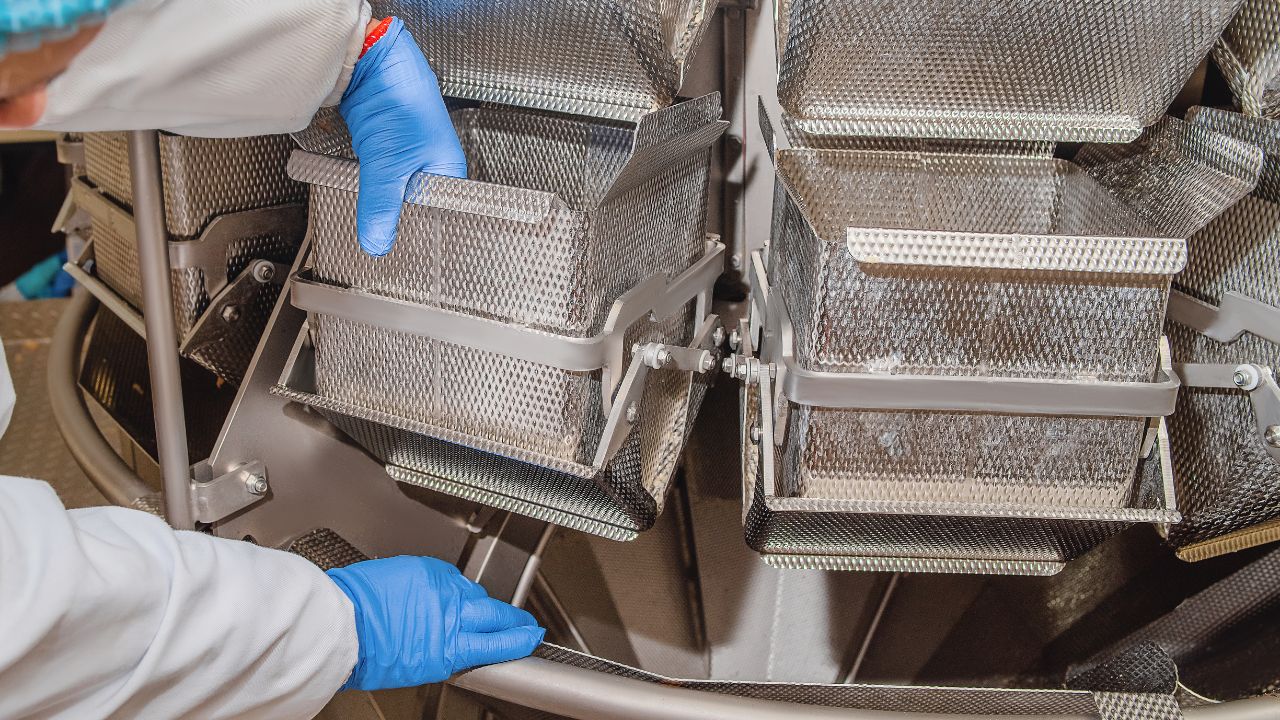
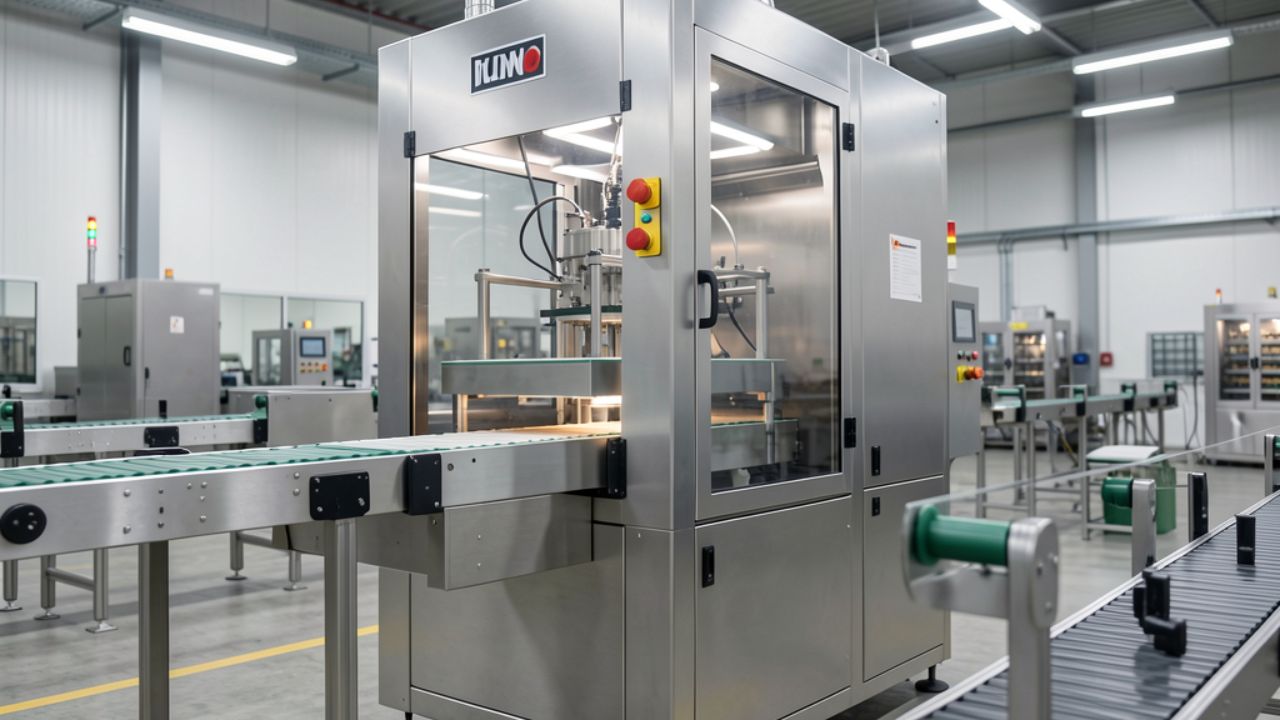
Every gram of product given away beyond the declared weight is profit lost. At the production scale, even 1% giveaway costs manufacturers tens of thousands of dollars annually. Multihead weighers solve this problem through combination-based weighing technology that evaluates thousands to millions of weight combinations per cycle, selecting the closest match to the target weight every time. This guide covers how these systems work, what drives sub-1% giveaway performance, and the calibration, maintenance, and inspection practices that keep weighing accuracy consistent across high-speed packaging lines.
Key Takeaways
- More heads mean fewer giveaways. A 24-head combination weigher evaluates over 16.7 million combinations per cycle, pushing giveaway below 0.5% compared to 0.8–1.5% on a 10-head system.
- Giveaway is expensive. A $10.00 product running 500,000 units at just 1% giveaway loses $50,000 annually. Cutting that to 0.5% saves $25,000 per year on a single product line.
- Product characteristics drive equipment decisions. Particle size, bulk density, moisture content, and flowability determine head count, hopper design, and feeder configuration. There is no one-size-fits-all setup.
- Calibration is non-negotiable. Daily zero checks, weekly span checks, and structured preventive maintenance are the foundation of sustained sub-1% giveaway performance.
- Weighing accuracy impacts the entire packaging line. Precision at the multihead weigher reduces waste, ensures regulatory compliance, cuts customer complaints, and directly supports accurate labeling and seal integrity downstream.
What is a Multihead Weigher? It's a Combination-Based Weighing System Built for Speed and Precision
A multihead weigher, also called a combination weigher, is an automatic packaging machine that uses multiple weighing heads to achieve precision weighing at production speed. It's the standard weighing technology for high-volume packaging lines across different industries.
The Core Technology Behind Multihead Weighers
The core intelligence of every multi-head weighing solution is its combination algorithm. A microprocessor evaluates all possible weight combinations across multiple weigh buckets and selects the one closest to target weight with minimal deviation. This combination-based weighing process scales exponentially with head count. A 10-head system produces 1,024 possible combinations. A 14-head produces 16,384. A 24-head system evaluates over 16.7 million combinations per cycle. Each additional weighing head doubles the algorithm's resolution for giveaway reduction.
Advanced algorithms optimize the weighing process dynamically, factoring in product density, product flow characteristics, and desired production speed. Booster hoppers with anti-stick hopper designs store pre-weighed product for immediate discharge, expanding available combinations while increasing both speed and weighing accuracy simultaneously.
How Multihead Weighers Optimize Efficiency in Packaging
Bucket configuration determines the balance of accuracy, speed, and cost across any packaging line. A 10-head industrial weigher runs 30 to 60 packages per minute with 0.8 to 1.5% giveaway. A 16-head system hits 80 to 120 ppm at 0.4 to 0.8% giveaway. High-speed multihead weighers with 24 heads reach 100 to 200 ppm and push giveaway below 0.5%. Premium 32-head configurations exceed 150 ppm with less than 0.3% giveaway.
High-precision load cells built into stainless steel weigh buckets deliver the foundation of this accuracy. Small products under 50g achieve ±0.1g precision. Medium products between 50g and 500g hold ±0.5g. Large products exceed ±1.0g. That load cell precision is what makes sub-1% giveaway achievable at scale.
Choose a 10 to 14 head multihead weigher if you run a single-product line at low to mid volume and need a cost-effective entry point. Choose a 16-head system if you need 80 to 120 ppm with sub-0.8% giveaway for mid-volume food packaging. Choose a 24-head configuration when packaging high-value products where every tenth of a percent in giveaway reduction impacts margins significantly. Choose a 32-head system when ultra-high-speed production and world-class accuracy below 0.3% giveaway are non-negotiable.
How Do Multi-Head Weighers Maintain Sub-1% Giveaway? Through Target Weight Strategy and Product-Specific Tuning
Maintaining sub-1% giveaway across variable product weights requires two things: precise target weight strategies tied to regulatory compliance, and equipment tuned to each product's physical characteristics.
Precision Weighing Techniques for Consistent Results
Manufacturers set target weights 0.3 to 0.8% above declared weight to balance giveaway reduction with regulatory compliance. The offset depends on which system applies. Under the Average Weight System used in the EU and UK, the batch average must meet declared weight, allowing a tighter 0.3 to 0.5% offset. Under the Minimum Weight System used in the USA, every individual package must comply, requiring a 0.5 to 0.8% offset.
The giveaway formula is straightforward: Giveaway (%) = [(Average Actual Weight minus Declared Weight) / Declared Weight] × 100. Real-time monitoring through Statistical Process Control charts tracks weighing accuracy against targets and catches trends before they become compliance issues.
Adapting to Different Product Weights and Sizes with Multihead Weighers
Product characteristics directly determine how well any combination weigher performs. Particle size uniformity is critical. Consistent particles flow predictably through vibratory feeder pans and fill weigh buckets uniformly. Irregular sizes reduce combinatorial efficiency. Bulk density consistency matters equally. Stable density supports reliable volumetric-to-weight relationships across the weighing process. Fluctuations from varying moisture content introduce variability that the algorithm must compensate for.
Flowability drives equipment configuration. Sticky products like dried fruit and gummy candies need anti-stick hoppers and steeper distributor angles. Fragile products like chips require gentle handling through the transition funnel. Powders and granule packaging applications demand anti-static measures and controlled airflow. Vibration feeder tuning across amplitude, frequency, and angle must ensure smooth, consistent product flow. Daily cleaning of linear feeders and regular checks for misalignment prevent friction changes that disrupt weighing accuracy.
What Are the Key Benefits of Sub-1% Giveaway? Lower Waste, Higher Margins, and Stronger Consumer Trust
Giveaway reduction directly impacts two areas that matter most to manufacturers: profit margins and product consistency. Even small improvements in weighing accuracy compound into significant annual savings.
Reducing Waste and Improving Profit Margins
At just 1% giveaway, the financial losses add up fast. A $5.00 product running 1,000,000 units annually loses $50,000. A $10.00 product at 500,000 units loses the same. A $20.00 product at 250,000 units hits $50,000 in waste. Cutting giveaway from 1.0% to 0.5% on that $10.00 product saves $25,000 per year.
Real-world numbers make it concrete. A 14-head combination weigher packaging 1.25 oz pistachios at 100 bags per minute at $10 per pound with 1g giveaway per bag loses roughly $130 every hour. If one weighing head goes down and giveaway rises to 2g per bag, the additional weekly loss reaches approximately $10,400. For high-value products like premium nuts, coffee, and pharmaceuticals, even a 0.1% giveaway reduction generates tens of thousands in annual savings across a single packaging line.
Enhancing Product Quality and Consumer Trust
Weighing accuracy tiers define where your operation stands. Standard systems with 10 to 14 heads deliver ±1.0 to 1.5g accuracy and 1.0 to 1.5% giveaway. Good-tier multi-head weighing solutions with 14 to 16 heads achieve ±0.5 to 1.0g and stay under 1.0%. Premium 16 to 24 head configurations hold ±0.3 to 0.5g. World-class high-speed multihead weighers with 24 to 32 heads and AI-enhanced algorithms push accuracy to ±0.1 to 0.3g with giveaway below 0.3%.
Consistent fill weights do more than meet food safety standards. They reduce customer complaints and minimize regulatory risk. Under the US Minimum Weight System, every package must meet declared weight. Sub-1% giveaway on a properly calibrated industrial weigher ensures virtually zero underfills and full regulatory compliance.
How Do Multihead Weighers Improve Labor Efficiency? By Replacing Manual Processes with Automated Precision Weighing
For manufacturers asking how to save labor shortages in food manufacturing, the answer starts on the packaging line. Automated weighing systems address both the labor crisis and the productivity gaps that manual processes create.
Automation's Role in Reducing Labor Shortages
The labor problem in food manufacturing is structural, not temporary. Manufacturers face over 40% turnover in machine operators within the first year. Each new hire costs $15,000 to $30,000 in recruiting and training, often lost when workers quit within weeks. Manual packaging operations that require 20 workers can be reduced to 5 with the right automatic packaging machine and multi-head weighing solutions. Companies that invest in packaging automation consistently report 30 to 40% reductions in labor costs. That savings compounds every year the labor market stays tight.
Streamlining the Packaging Process for Increased Productivity
Beyond labor reduction, automated combination weighers fundamentally change production speed and consistency. Modern weighing systems deliver 50 to 200+ packages per minute with 99.5% or better fill accuracy. That level of precision weighing is impossible to sustain manually regardless of workforce size.
User-friendly interfaces with touchscreen HMI controls let operators learn the system in days instead of weeks. That matters when turnover is high and training budgets are limited. Modular, tool-free changeover designs built from stainless steel components allow crews to switch between products or package sizes in under 30 minutes. Traditional packaging lines with manual adjustments can take hours for the same transition. The result is less downtime, fewer operators, and higher throughput per shift across every product run.
Which Industries Benefit Most from High-Accuracy Multihead Weighers? Food, Pharma, Supplements, and Chemical Manufacturing
High-accuracy weighing systems serve different industries with distinct product challenges. The common thread is that precision weighing directly impacts profitability, compliance, and product quality across every sector.
Food and Beverage Manufacturing
Food and beverage accounts for 36% of the packaging machinery market, making it the largest segment for multihead weigher deployment. Key product categories include snack foods, frozen foods, dry goods, pet food, coffee, spices, seasonings, confectionery, nuts, and dried fruits. Products like nuts and snacks with varying piece sizes benefit most from higher head counts. A 16 to 24 head combination weigher provides the combinatorial accuracy needed for granule packaging and irregular product shapes common in pack-in-pack formats.
Environmental controls are critical across food packaging lines. Powders and spices require anti-static measures to prevent product from clinging to weigh buckets and vibratory feeder pans. Hygroscopic products need humidity control to prevent moisture absorption during the weighing process. Temperature stability protects load cell accuracy across extended production runs. Meeting food safety standards starts with controlling these variables at the equipment level.
Pharmaceuticals and Other Precision Packaging Applications
Pharmaceutical packaging demands the highest regulatory compliance requirements, including FDA and GMP standards. Every gram matters. World-class giveaway targets below 0.3% are standard for high-value pharma products, enabled by 24 to 32 head industrial weigher configurations with AI-enhanced algorithms.
Dietary supplements and nutraceuticals represent a fast-growing segment. Protein powder, collagen, vitamins, and sports nutrition products all require precision weighing with consistent product flow through specialized hopper designs. Chemical and industrial products, including detergents, industrial powders, and agricultural chemicals, form a specialty segment where weighing accuracy and material-specific equipment configurations drive performance across dedicated packaging lines.
Choose a 16 to 24 head combination weigher with anti-stick hoppers if you package snacks, nuts, or confectionery with irregular piece sizes. Choose a 24 to 32 head system with AI-enhanced algorithms if you operate in pharmaceuticals or supplements where FDA compliance and sub-0.3% giveaway are mandatory. Choose a configuration with specialized moisture-resistant components and environmental controls if your products are hygroscopic powders, spices, or chemicals sensitive to humidity and static.
What Are the Best Practices for Maintaining Weighing Accuracy? Disciplined Calibration, Preventive Maintenance, and Integrated Inspection Systems
Sustained weighing accuracy is not a set-and-forget outcome. It requires structured calibration schedules, environmental controls, and real-time quality verification through inspection systems.
Calibration and Maintenance for Consistent Performance
Calibration follows a strict schedule. Daily zero checks verify empty weigh bucket readings. Weekly span checks use certified test weights to confirm load cell accuracy. Environmental changes like temperature shifts or seasonal humidity swings may require more frequent calibration since load cell electronics are sensitive to fluctuations that cause drift.
Load cell protection is equally important. Shield sensors from strong airflows, isolate the industrial weigher from nearby vibrating equipment, and never overload beyond rated capacity. Structured preventive maintenance covers daily cleaning of vibratory feeder pans and linear feeders, weekly sensor and vibrator checks, monthly calibrations, and annual deep maintenance. Algorithm parameters must be tuned per product with appropriate bucket volume fill targets, combination windows, and speed-accuracy trade-off settings. Product uniformity remains the single most impactful factor. Upstream process control directly enables downstream weighing accuracy on every packaging line.
Integration with Inspection Systems for Enhanced Accuracy
Inline inspection systems like check weighers identify and remove underweight or overweight products post-weighing, closing the quality loop. Statistical Process Control charts enable early detection of process drift. Control limits set at ±3 sigma from the process mean catch problems early. Warning limits at ±2 sigma trigger investigation before a breach occurs. Trend rules flagging seven consecutive points moving in one direction indicate systematic changes in the weighing process.
Cpk analysis quantifies process capability against specification limits. A Cpk of 1.33 or higher is the minimum acceptable for most food applications and regulatory compliance. These upstream-downstream dependencies matter. Weigher accuracy directly affects downstream labeling requirements and weight declarations, linking precision weighing to end-to-end compliance.
Ready to Cut, Giveaway, and Scale Your Packaging Line?
Wolf-Packing Machine Company designs and builds precision multihead weighers, high-speed vffs machine systems, and complete packaging solutions engineered for sub-1% giveaway performance. As a veteran-owned, American-made manufacturer, we provide everything from custom machine design to lifetime technical support. No overseas delays. No disappearing after the sale. Whether you're automating for the first time or upgrading existing weighing systems, our engineering team will build a solution matched to your products, your facility, and your growth goals. Contact Wolf-Packing today for a free consultation.