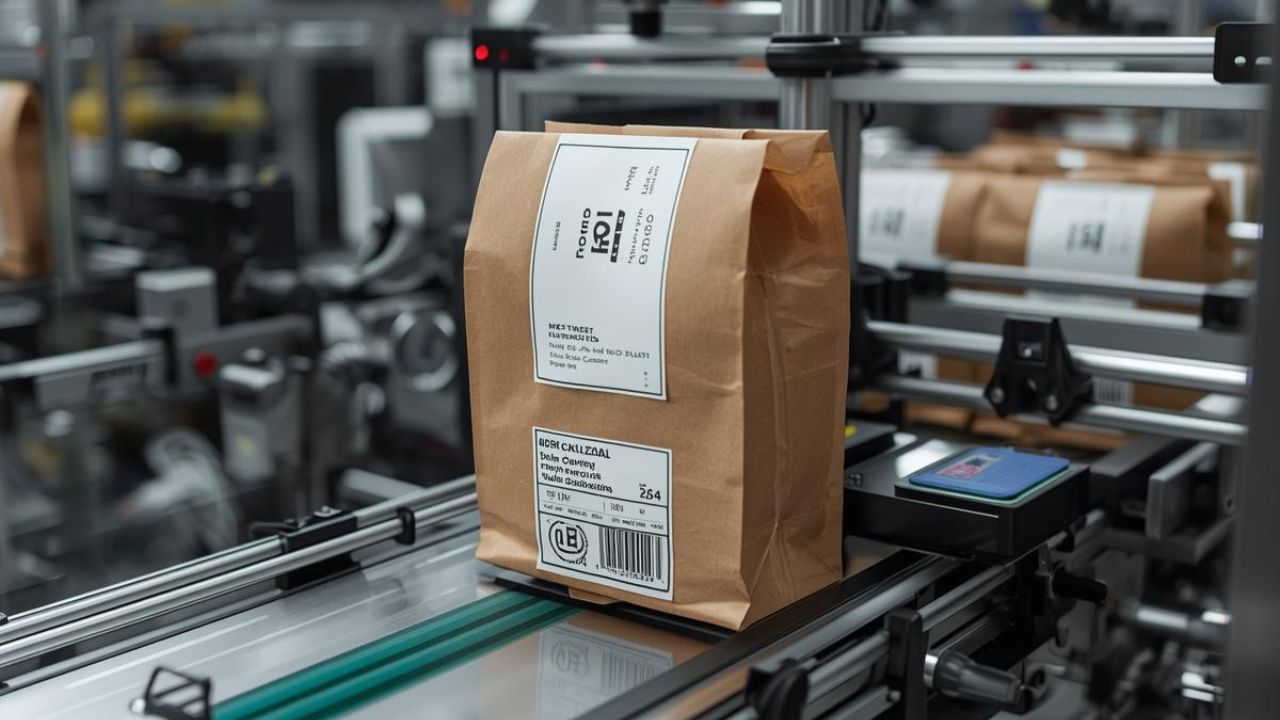
Label placement on flexible packaging determines whether your products scan correctly at retail checkout, move efficiently through distribution centers, and meet retailer compliance requirements. A label placed on a seal, wrinkle, or curved surface can reduce barcode scan reliability from 96% to 45%, triggering manual intervention at every supply chain touchpoint.
Front center placement achieves 92-96% scan reliability across all bag types, dramatically outperforming seal and gusset zones that achieve only 45-52% reliability, well below the GS1 minimum threshold of 85%.
Seal zones, wrinkles, and curved surfaces cause barcode scan failures due to surface irregularities that create shadows and distort barcode geometry, resulting in ISO grades below retailer requirements.
GS1 standards require quiet zones of at least 10 times the X-dimension on both sides of barcodes and mandate placement on flat, smooth surfaces away from seams, curves, and folds.
Bag material determines adhesive requirements, with low surface energy plastics requiring aggressive acrylic or rubber-based adhesives, while paper bags accept standard permanent adhesives.
Optimized label placement eliminates retailer chargebacks, as demonstrated by a case study where repositioning labels improved first-pass scan rates from 79% to 97% and eliminated all chargebacks within one quarter.
Why Is Label Placement Important For Bags Used In Retail and Distribution?
Effective retail bag labeling requires understanding how placement affects scanning accuracy, warehouse handling, shelf visibility, and logistics operations across multiple industries. The difference between a 96% scan rate and a 52% scan rate comes down to placement zone selection.
How Does Label Placement Affect Barcode Scanning And Tracking Accuracy?
Front center placement on bags achieves 92-96% scan reliability across all bag types. Seal and gusset zones achieve only 45-52% scan reliability, falling dramatically below the GS1 minimum threshold of 85%. When labels are placed on curved, sealed, or folded surfaces, scanners cannot read the barcode geometry correctly, resulting in failed scans and manual intervention.
How Does Label Placement Improve Warehouse Handling And Sorting?
Front center zones score 7-8 out of 10 for durability, while seal zones score only 3-5 out of 10. Labels placed on seals, gussets, or high-friction areas peel off during conveyor handling, pallet stacking, and shipping vibration. Inspection systems can verify label placement accuracy before packages enter the distribution network.
How Does Label Visibility Influence Retail Shelf Identification?
Front panel center placement scores 9-10 out of 10 for retail visibility, allowing consumers to identify products immediately. Back panel center scores 6 out of 10, requiring the consumer to rotate the package. Seal and gusset zones score 1-2 out of 10, making product identification nearly impossible without multiple handling steps.
Why Does Incorrect Label Placement Cause Logistics Errors?
A snack food manufacturer received consistent retailer chargebacks due to barcode scan failures when labels were placed over the back fin seal. The initial first-pass scan rate was only 79% with an ISO grade C, below the retailer's minimum requirement of grade B.
Common operational issues:
Scanning failures at automated checkout and warehouse gates
Misidentification during sorting processes
Damaged labels during handling due to placement on high-friction zones
Delays in warehouse processing require manual intervention
What Types Of Labels Are Applied To Bags In Retail And Distribution?
Bags carry multiple label types serving distinct supply chain functions. Understanding each label type ensures proper bag label positioning and compliance.
What Are Product Identification Labels On Retail Bags?
Product identification labels display the Principal Display Panel (PDP) containing the statement of identity and net quantity of contents. FDA 21 CFR Part 101 requires the PDP to appear prominently on the package front. The information panel, typically positioned immediately to the right of the PDP, contains nutritional facts, ingredient lists, and allergen warnings.
What Are Shipping And Logistics Labels On Distribution Bags?
Shipping labels contain GTINs, batch/lot numbers, and expiration dates required for supply chain tracking. Walmart's Supply Chain Packaging Guide mandates GS1-128 barcodes for logistic units incorporating SSCC-18 codes. Pallet labels should be positioned between 400-800mm from the base for easy scanning.
What Are Barcode And QR Code Labels Used For Inventory Management And Tracking?
Linear barcodes (EAN-13, UPC-A) are used at retail point-of-sale. GS1-128 barcodes encode multiple data fields for case-level tracking. QR codes and DataMatrix codes store serialized data for pharmaceutical track-and-trace compliance.
What Are Compliance, Safety, And Regulatory Labels?
Label Type
Purpose
Example Information
Compliance Labels
Meet regulatory requirements
FDA nutritional information, allergen warnings
Safety Warnings
Alert handlers to product hazards
"Fragile," "Keep Refrigerated," "Flammable"
Certification Labels
Verify product meets standards
USDA Organic, Fair Trade, Kosher, Halal
Recycling Markings
Guide proper disposal
Recycling symbols, material composition codes
Where Should Labels Be Placed On Bags For Maximum Visibility And Scannability?
Front center placement consistently outperforms all other zones across every performance metric. Avoid placement on seals, gussets, and curved surfaces.
Should Labels Be Placed On The Front Panel Of A Bag?
Yes, the front center is the preferred placement zone. Stand-up pouch front panel center achieves 96% scan reliability, 10 out of 10 retail visibility, and GS1 Preferred status. Flat bag front center achieves 94% scan reliability, 9 out of 10 retail visibility, and GS1 Preferred status. Front center consistently achieves the highest performance across all bag types produced by pre-made pouch bagging machines.
When Should Labels Be Placed On The Side Panels Of A Bag?
Avoid side panel placement. Flat bag side seal placement achieves only 48% scan reliability, 2 out of 10 retail visibility, and carries a GS1 status of Not Recommended. Side seals are structurally compromised zones where labels cannot adhere reliably.
Can Labels Be Placed Near The Top Area Of A Bag For Easy Scanning?
Top placement is acceptable but suboptimal. Stand-up pouch front panel top achieves 88% scan reliability and GS1 Acceptable status. Flat bag front top achieves 85% scan reliability (just meets the GS1 minimum threshold). Pillow bag front top achieves 83% scan reliability (below the GS1 threshold).
Why Should Labels Avoid Seams, Edges, Handles, And Fold Lines?
The GS1 General Specifications state: "The barcode should be placed on the natural bottom of the package or on a panel adjacent to the natural bottom, on a flat, smooth surface, avoiding seams, curves, and folds." A case study found that a 3mm raised ridge from a fin seal reduced scan reliability by 21% (from 97% to 79%).
Areas that interfere with label readability:
Seams: Create raised surfaces that distort barcode geometry
Folded surfaces: Cause labels to wrinkle, making barcodes unreadable
Bag handles: High-abrasion zones where labels peel or become damaged
Highly curved surfaces: Cause perspective distortion for vision systems
What Factors Determine The Optimal Label Placement On Bags?
A comprehensive distribution labeling strategy accounts for bag material, size, shape, warehouse handling patterns, and scanner orientation.
How Does Bag Material Affect Label Adhesion and Placement?
Low surface energy plastics like polyethylene and polypropylene require aggressive adhesives with high initial tack. Paper bags accept standard adhesives easily due to their porous surface.
Bag Material
Adhesion Difficulty
Placement Considerations
Plastic Bags (PE/PP)
Moderate to High
Requires aggressive acrylic or rubber-based adhesives
Paper Bags
Low
Standard permanent acrylic adhesives work well
Woven Polypropylene
High
Requires conformable materials (BOPP or vinyl) with aggressive adhesives
Laminated Packaging
Low to Moderate
Standard pressure-sensitive adhesives perform well
How Do Bag Size And Shape Influence Label Positioning?
Stand-up pouches have a bottom gusset that creates a highly curved, multi-layered surface entirely unsuitable for label placement. Flat bags produced by horizontal flow wrapping systems have a top seal, bottom seal, and back fin seal, all three seal zones must be avoided. The front and back panels remain the only viable options.
How Do Handling Processes In Warehouses Affect Label Placement?
Gusset/bottom zones on stand-up pouches score only 5 out of 10 for durability due to constant shelf contact and abrasion. Back panel center placements score 7 out of 10 for durability. Labels placed in high-contact zones peel off during normal distribution operations.
How Do Barcode Orientation And Scanner Angles Influence Placement?
The "picket fence" orientation (vertical bars running parallel to the package's vertical axis) is generally preferred because it is less susceptible to the "ladder" effect, where slight curvature causes a horizontal barcode to appear curved to a scanner.
Barcode orientation best practices:
Vertical "picket fence" orientation: Minimizes impact of package curvature
Maintaining flat placement surfaces: Eliminates distortion that confuses scanners
Avoiding wrinkles during application: Prevents dark voids that scanners interpret as missing bars
What Standards And Best Practices Guide Label Placement In Retail And Distribution?
Industry standards from GS1, FDA, and major retailers establish minimum requirements for label placement, barcode quality, and information display.
What Barcode Placement Guidelines Improve Scan Reliability?
For a standard EAN-13 barcode, the minimum quiet zone is 3.63mm on the left and 2.31mm on the right. The general industry standard requires quiet zones to be a minimum of 10 times the narrowest bar width (X-dimension) on both sides.
Widely accepted barcode placement practices:
Maintaining adequate quiet zones (minimum 10x the X-dimension on both sides)
Avoiding curved surfaces that distort barcode geometry
Positioning barcodes at consistent heights for automated scanning systems
Ensuring sufficient contrast between the barcode and the background
How Do Retail Compliance Requirements Influence Label Placement?
Amazon's FBA Labeling Requirements mandate that each sellable unit must carry a unique FNSKU label placed on a flat surface, covering any existing manufacturer barcodes. After repositioning labels to meet retailer compliance requirements, the snack food manufacturer eliminated all chargebacks within the first quarter.
Why Is Consistent Label Positioning Important Across Packaging?
Consistent placement enables automated scanning systems to locate barcodes without manual intervention. Standardized placement across product lines allows distribution centers to configure fixed-position scanners at optimal heights and angles, maximizing first-pass read rates.
How Can Businesses Determine The Optimal Label Placement On Bags?
Start by defining each label's purpose, then identify the flattest available surface, verify barcode readability, test in distribution conditions, and standardize placement.
How Should Businesses Identify The Primary Purpose Of Each Label?
Typical label purposes:
Product identification: Brand name, visual appeal for retail shelf presence
Shipping tracking: SSCC-18 codes, carrier tracking numbers, destination information
Branding and marketing: Logos, promotional messages, QR codes
How Should the Most Visible Surface Area of the Bag Be Selected?
Front center achieves 9-10 out of 10 for retail visibility, back center achieves 6 out of 10, and seal zones achieve 1-2 out of 10. The front and back panels of stand-up pouches are relatively flat and stable when filled, making them preferred zones.
How Should Barcode Readability And Orientation Be Verified?
ISO grade B is the minimum requirement for most major retailers. Initial placement achieving only ISO grade C resulted in a 79% first-pass scan rate. Verify barcode quality using a handheld barcode verifier before approving artwork.
Verification checks:
Perform first-pass read rate tests with handheld and fixed-position scanners
Verify labels are on smooth surfaces free from ridges, seams, or curves
Validate that barcode dimensions meet GS1 specifications
Test under warehouse fluorescent, retail LED, and outdoor natural lighting
How Should Label Placement Be Tested in Real Distribution Conditions?
Ship test units through warehouses, distribution centers, and retail stores to identify placement failures. ISTA Test Procedure 2A provides a standardized distribution simulation protocol. Test results reveal whether labels remain adhered and scannable after vibration, drop testing, and compression cycles.
How Should Businesses Standardize Label Placement Across Product Lines?
Create a placement specification document that defines exact coordinates, orientation, and quiet zone requirements for each bag type. Standardization reduces artwork errors, simplifies machine changeovers, and ensures consistent scan performance. Packaging automation systems benefit from standardized label placement.
What Common Label Placement Mistakes Should Businesses Avoid?
The most common errors involve placing labels on seams, wrinkles, curved surfaces, and zones that experience abrasion during handling.
Why Does Placing Labels Over Seams Or Wrinkles Cause Problems?
Stand-up pouch gusset/bottom placement achieves only 52% scan reliability, 37% below the GS1 threshold. Flat bag side seal placement achieves 48% scan reliability. Pillow bag bottom seal placement achieves 45% scan reliability. All seal zone placements fall dramatically below the GS1 minimum acceptable threshold of 85%.
Why Do Poorly Positioned Barcodes Fail During Scanning?
Placement over a back fin seal caused barcodes to achieve only ISO grade C and a 79% first-pass scan rate. After moving to the front center panel, the same product achieved ISO grade B and a 97% first-pass scan rate. The 3mm raised ridge from the seal created a shadow effect that scanners interpreted as voids in the barcode.
How Do Overlapping Labels Create Confusion In Distribution?
When multiple barcodes appear within scanner range, automated systems cannot determine which code to read, resulting in no-read errors or incorrect product identification. Logistics labels must never overlap product identification barcodes.
How Can Incorrect Label Placement Slow Down Warehouse Operations?
Operational consequences:
Manual rescanning: Operators must manually position and rescan packages when automatic scanners fail
Sorting errors: Misread barcodes cause packages to be routed to wrong locations
Delayed shipments: Packages with unreadable labels are pulled for manual processing
How Does It Improve Inventory Accuracy And Traceability?
When barcodes scan correctly at every touchpoint, receiving, put-away, picking, packing, and shipping, inventory systems maintain accurate counts without physical audits. Product serialization and lot tracking depend on consistent barcode readability.
How Does It Reduce Manual Handling And Scanning Errors?
Repositioning labels from seal zones to front center eliminated retailer chargebacks within one quarter in the documented case study. The first-pass scan rate improved from 79% to 97%, reducing manual intervention by approximately 18 percentage points.
How Does It Speed Up Receiving, Sorting, And Shipping Processes?
Distribution centers equipped with automated conveyors and fixed-position scanners achieve maximum efficiency when labels are positioned consistently across all incoming SKUs, eliminating the need for manual adjustments or secondary scans.
What Are The Key Principles For Optimal Label Placement On Bags?
Optimal placement follows consistent principles across all bag types and applications to ensure scan reliability, retail visibility, and label durability.
Which Visibility And Accessibility Principles Should Always Be Followed?
Core principles:
Maintaining flat surfaces: Place labels on the smoothest, most stable panel (front center for most bag types)
Ensuring unobstructed visibility: Avoid areas that will be covered, creased, or obscured during handling
Keeping labels away from edges: Maintain a minimum 5-10mm clearance from bag edges
Placing labels where scanners naturally align: Position barcodes at consistent heights for automated scanning
Which Consistency Practices Help Maintain Reliable Label Placement Across Operations?
Standardization practices:
Fixed label zones on packaging: Define and document specific placement zones
Consistent barcode orientation: Standardize on vertical "picket fence" orientation
Uniform label sizes: Use consistent label dimensions to simplify equipment setup
Implement Optimal Label Placement To Improve Your Packaging Efficiency
Optimal label placement on bags requires selecting the front center zone, avoiding seal areas and curved surfaces, maintaining GS1 quiet zone requirements, and verifying barcode readability under real distribution conditions. Front center placement consistently achieves 92-96% scan reliability across stand-up pouches, flat bags, and pillow bags, while seal zone placement falls to 45-52% reliability.
Businesses that standardize placement specifications, test labels through actual distribution networks, and match adhesive chemistry to bag materials eliminate costly chargebacks and reduce warehouse processing time. When labels scan reliably on the first pass, automated systems move products faster, and operational costs decrease.
Wolf Packing provides automated labeling systems designed for reliable label application on flexible packaging. Contact our packaging engineering team to optimize your label placement strategy.
At Wolf-Packing Machine Company, we believe that the key to success is a commitment to excellence in everything we do. That’s why we use only the highest quality materials and the most advanced technology to create packaging machines that are efficient, reliable, and cost-effective.
What’s new at Wolf Packing?
// <#?php
// /**
// * Exclude Current Posts from the query
// */
// add_action( 'pre_get_posts', function ( $query ) {
// // not an admin page and not the main query
// if ( ! is_admin() && ! $query->is_main_query() ) {
// $query->set( 'post__not_in', array( get_the_ID() ) );
// }
// } );
// ?>
From design through testing, installation and beyond, we work tirelessly to ensure your equipment is running at peak performance and maximizing your application. To learn more about our machines, reach out to set up a free consultation with our in-house experts.
From weigh filling, bagging, wrapping and conveying to capping, labeling, cartoning, case/tray forming, packing and palletizing, we offer packaging solutions for a diverse array of applications.